A jewelry laser welder and a spot welder can both join very small metal parts, but they do not work in the same way—and they are not equally suited to every jewelry repair.
For professional jewelers, the biggest difference is how precisely you can control where the energy goes.
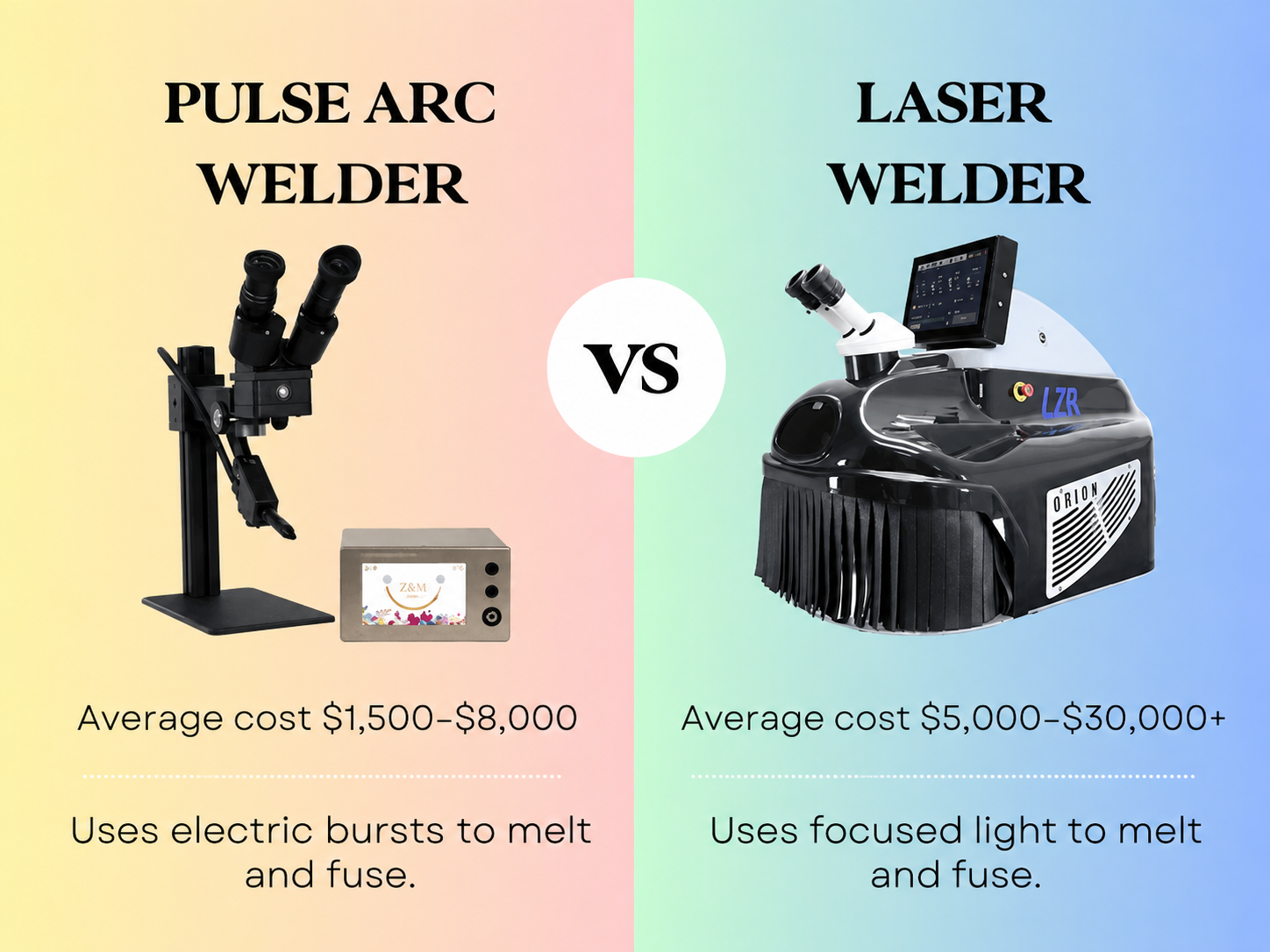
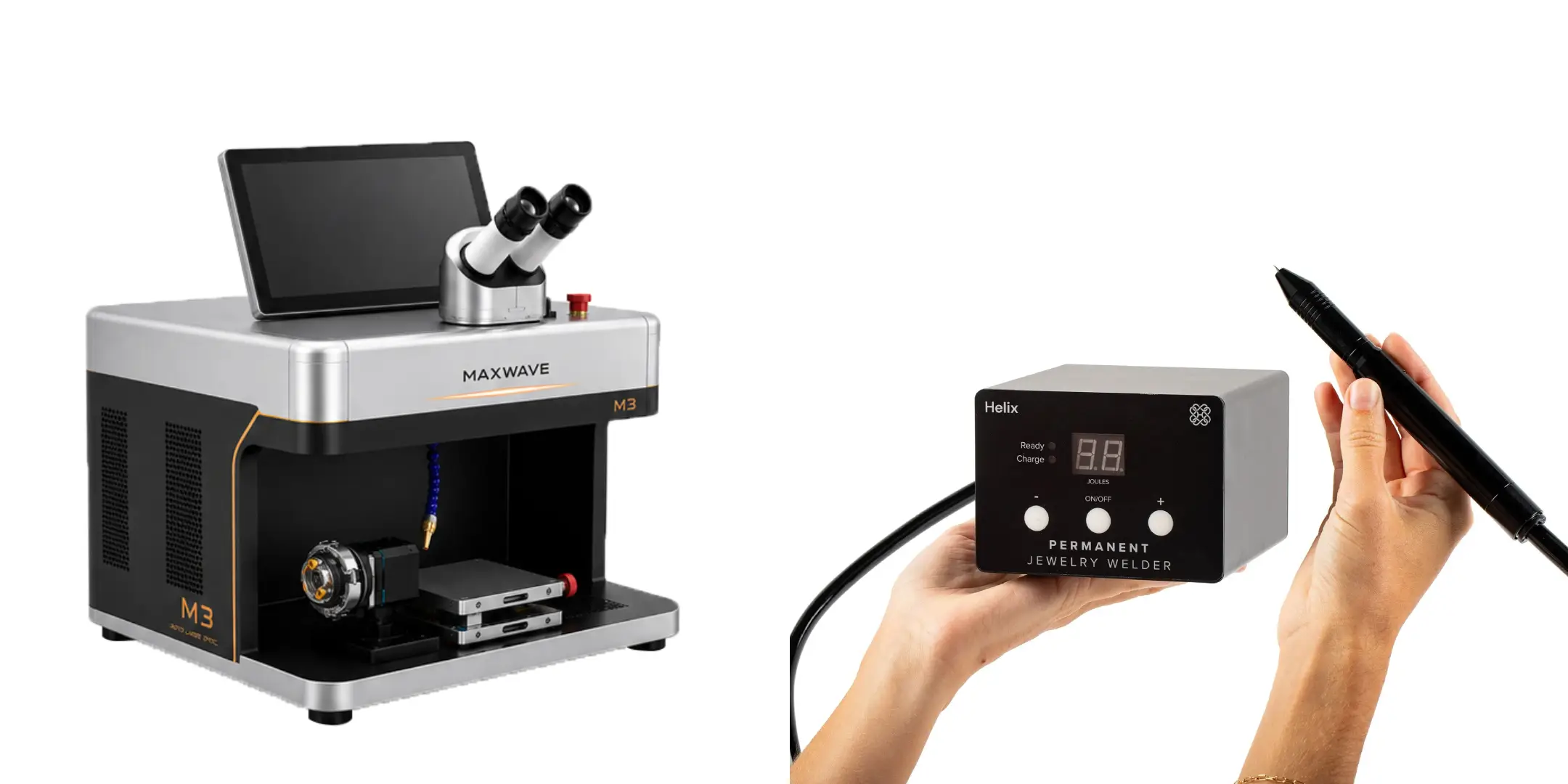
A jewelry laser welder uses a focused beam of light. The operator can adjust the weld energy and spot diameter independently, allowing a very small weld zone to be placed exactly where it is needed.
A pulse-arc or micro-TIG jewelry welder uses electrical energy to create a tiny plasma arc between an electrode and the workpiece. On these systems, increasing energy generally also increases the weld spot. Sunstone, which manufactures both technologies, specifically identifies this independent spot-size control as one of the major advantages of laser welding.
That leads to a fairly simple starting point:
Choose a laser welder when precision, difficult access, thin jewelry, stone-set repairs, and finishing quality matter most.
Choose a pulse-arc/spot welder when lower equipment cost, compact size, silver performance, and straightforward joining jobs matter more.
Neither technology is universally better.
The right choice depends on what actually crosses your bench.
Comparison | Jewelry Laser Welder | Pulse Arc / Spot Welder |
|---|---|---|
Energy source | Focused laser beam | Electrical arc / plasma discharge |
Spot control | Energy and spot size can be adjusted independently | Spot size generally changes with energy |
Heat localization | Excellent | Very good |
Fine / thin jewelry | Excellent | Good |
Hard-to-reach areas | Strong advantage | Electrode access can limit some welds |
Stone-set repairs | Excellent when properly operated | Possible, but access and arc control matter more |
Silver | Capable, but reflectivity can make it more demanding | Often particularly strong |
Ring sizing / prongs | Excellent | Capable depending on job |
Simple chain / joining work | Excellent but may be more machine than needed | Very practical |
Initial investment | Usually higher | Usually lower |
Best fit | Professional repair and high-value work | Budget-conscious or complementary bench welding |
For many jewelry workshops, the question is therefore not “Which technology can weld jewelry?”
Both can.
The better question is:
Which one gives you the control, productivity, and repair range your customers actually require?
1. Jewelry Laser Welder vs Spot Welder: The Core Difference
The difference starts with how the weld is created.
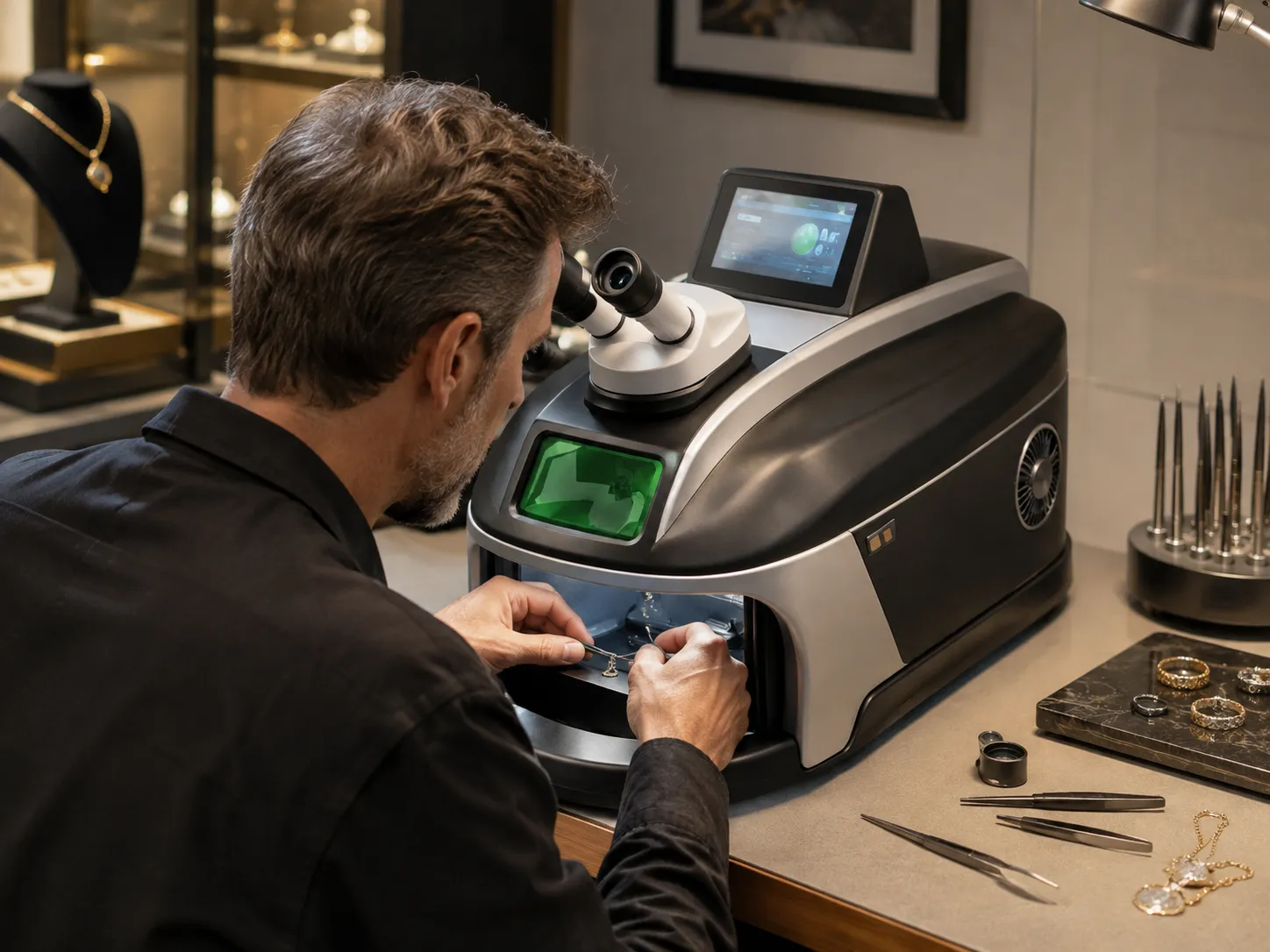
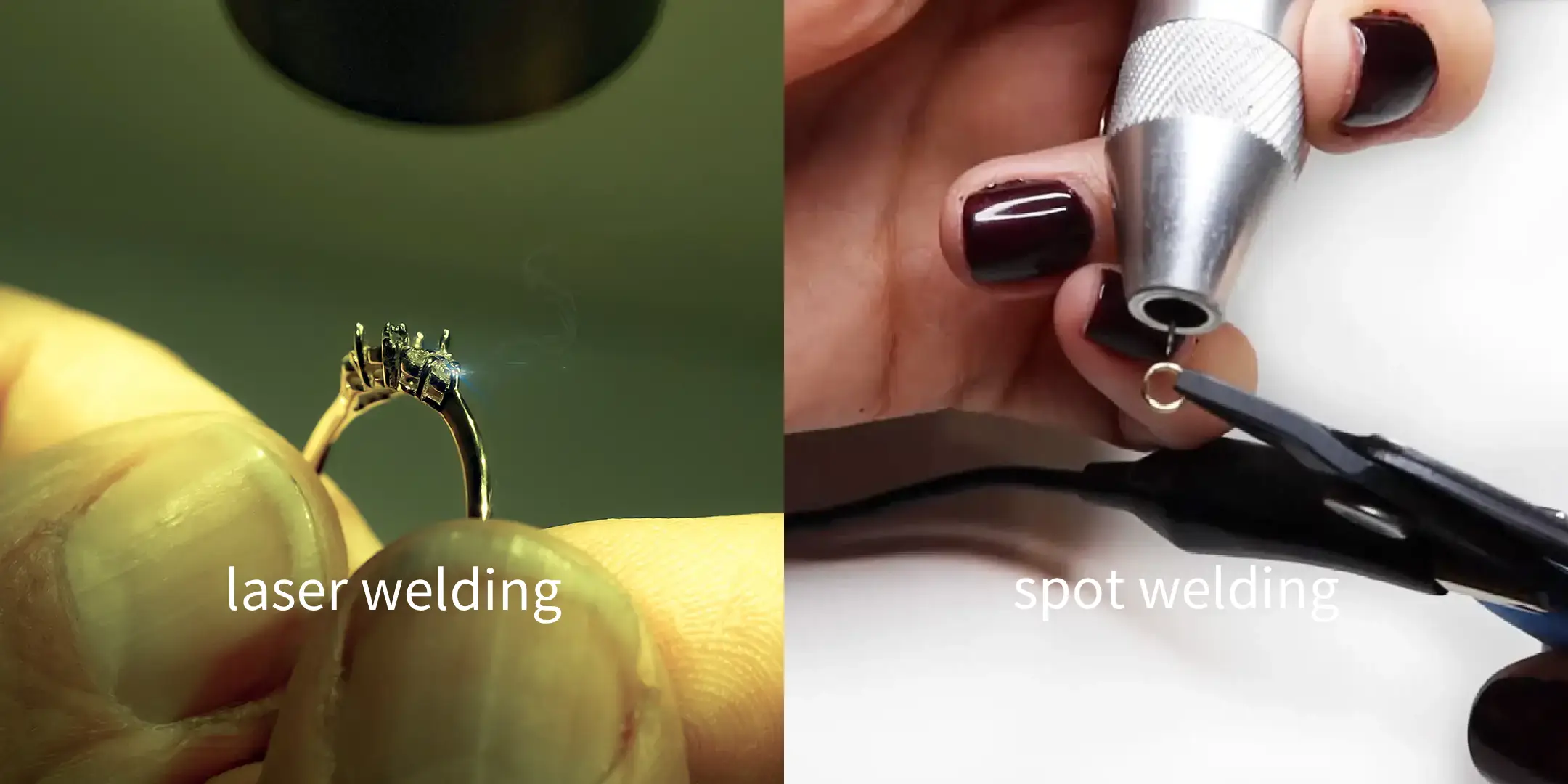
A jewelry laser welder for professional repair shops directs a short laser pulse through the microscope crosshair onto a precisely selected point of the jewelry.
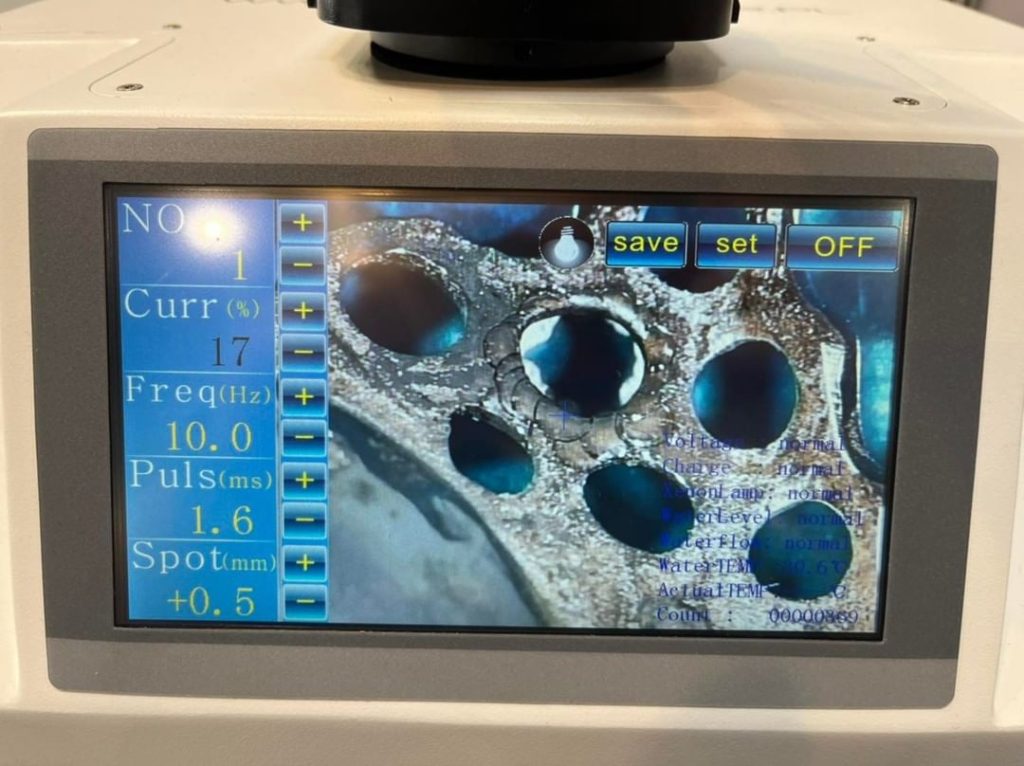
Professional jewelry laser systems allow operators to adjust parameters such as pulse energy, pulse duration, repetition rate, and spot size. LaserStar describes typical jewelry laser spot sizes ranging roughly from 0.2 to 2.5 mm depending on the machine and application.
The jeweler positions the workpiece under a microscope, aligns the joint, adds filler wire when required, and triggers the weld.
The energy is concentrated into a small area for a very short period.
That localized process is why laser welding is widely used for ring sizing, prong retipping, bezel repair, porosity filling, chain repair, jewelry assembly, and work around existing settings. LaserStar currently lists those among the core applications of its jewelry laser systems.
A pulse-arc welder works differently.
The jewelry is electrically grounded, and the operator brings a tungsten electrode into position. When the welding cycle is triggered, a small plasma discharge melts the metal in milliseconds. Filler material can also be added to build joints or seams.
The process is still highly localized compared with traditional torch soldering.
But there is an important practical difference:
The electrode must physically approach the weld location.
That can become a limitation when the joint sits deep inside a setting, behind another component, or in another geometrically difficult location. Sunstone identifies required electrical contact and electrode access as one of the limitations of pulse-arc welding.
A laser beam does not have the same electrode-access requirement.
That makes precision laser welding for jewelry repair particularly useful for complicated high-value pieces.
Heat Control Is Important—but Do Not Oversimplify It
Both technologies localize heat much better than traditional torch work.
However, laser welding generally gives the operator more independent control over the energy density and spot size.
That can be especially valuable when working on:
Thin prongs.
Fine chains.
Antique jewelry.
Small cracks.
Porosity.
Thin-walled settings.
Repairs close to gemstones.
This does not mean a laser can be fired carelessly next to every gemstone.
Different stones, treatments, inclusions, fillers, adhesives, and settings respond differently to heat and shock.
Stone-adjacent welding still requires professional judgment regardless of the machine.
The real advantage is that the laser gives the operator more tools for controlling exactly where the welding energy is delivered.
2. Which Is Better for Common Jewelry Repairs?
This is where the difference between the two machines becomes much clearer.
You should choose according to your repair mix rather than comparing specification sheets in isolation.
Ring Sizing
For professional ring sizing, particularly on gold, platinum, stone-set rings, or pieces where minimizing surrounding heat matters, laser welding is usually the more versatile choice.
The operator can adjust the spot and pulse according to the thickness of the shank and gradually build the joint with filler material.
Laser welding is also widely used for resizing rings without removing certain stones when the specific stone and setting allow it.
A pulse-arc welder can also perform ring work, especially on accessible joints.
But if ring sizing represents a large percentage of your professional repair business, the flexibility of a laser welder for ring sizing and jewelry repair becomes increasingly valuable.
Prong Retipping and Setting Repair
This is one of the strongest applications for laser welding.
The work area is tiny, visual precision is critical, and there may be a valuable gemstone only millimeters away.
The jeweler needs to add a controlled amount of metal, rebuild the worn area, and minimize unnecessary finishing afterward.
LaserStar specifically promotes laser systems for retipping gold and platinum prongs and repairing bezel settings.
Pulse arc can also perform precise jewelry work, but laser's independently adjustable weld spot gives it an advantage when you need very small, controlled deposits.
Chain and Clasp Repair
This comparison is more balanced.
Both technologies can repair chains, clasps, bracelets, earrings, and small jewelry components.
For a shop mainly performing straightforward chain repairs and simple joining work, investing in a full benchtop laser may not always be financially necessary.
A compact pulse-arc machine can provide strong capability at a lower capital cost.
But the equation changes if those chain jobs are mixed with prong work, ring sizing, platinum, porosity, antique restoration, and other precision repairs.
In that case, the laser provides a broader repair platform.
Silver Jewelry
Silver deserves special attention.
Silver is highly reflective and thermally conductive, which can make laser welding more demanding depending on the machine's peak power and pulse characteristics.
Pulse-arc systems do not depend on optical absorption in the same way. Sunstone identifies reflective metals such as silver and copper as a particular strength of pulse-arc welding.
That does not mean lasers cannot weld silver.
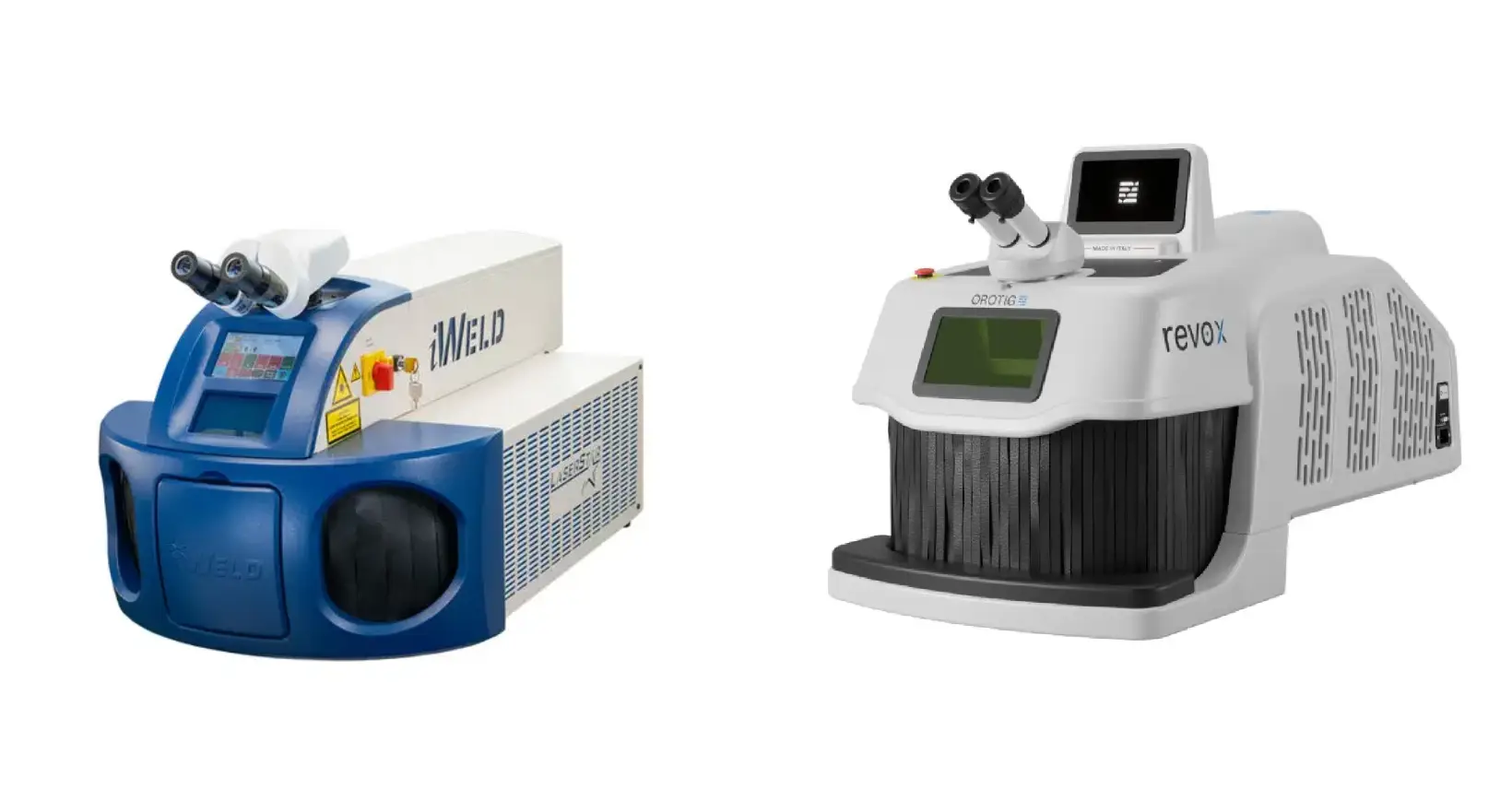
Modern professional jewelry lasers are specifically designed to handle silver as well; LaserStar's current iWeld, for example, explicitly lists silver alongside gold and platinum capability.
So the better conclusion is:
For a silver-heavy workshop, pulse arc deserves serious consideration.
For a mixed gold, silver, platinum, stone-set, and high-value repair shop, a capable laser system usually offers the broader range.
Platinum and High-Value Jewelry
Laser welding becomes particularly attractive as the value and complexity of the jewelry increase.
Platinum ring work, detailed settings, antique restoration, porosity filling, and mixed fabrication all benefit from the ability to place small, controlled welds exactly where needed.
The machine also allows the operator to widen the beam and use lower energy for smoothing welded areas, something Sunstone notes can generally be accomplished more quickly with a laser than with pulse arc.
This can reduce the amount of filing and finishing required after certain repairs.
That matters because workshop profitability is influenced not only by how quickly you can make the weld, but by how quickly the entire repair leaves the bench.
3. Cost, Workflow and Workshop Fit
Pulse-arc machines generally have a significant advantage in initial investment.
They are typically smaller, simpler to install, and require less bench space.
Sunstone's own laser-versus-pulse-arc comparison positions pulse arc as the lower-capital technology, while full benchtop laser welding systems occupy a substantially higher investment category.
That can make pulse arc extremely attractive for:
New jewelry businesses.
Solo jewelers.
Small repair benches.
Silver-focused work.
Studios with relatively low repair volume.
Jewelers who need welding capability but cannot yet justify a professional laser system.
The lower investment also means the machine can potentially begin generating a return sooner.
But purchase price should not be viewed alone.
A Laser Welder Usually Provides a Broader Repair Envelope
A professional laser welder is more expensive partly because it gives the operator greater control.
For example, current professional benchtop systems can provide:
Adjustable spot diameter.
Pulse energy control.
Pulse-width control.
Microscope targeting.
Memory settings.
Jewelry repair presets.
Integrated cooling.
Argon shielding capability.
Large working chambers.
This broader operating range becomes more valuable as the repair mix becomes more complex.
If you regularly outsource jobs because your current equipment cannot safely or precisely complete them, the additional capability can create revenue rather than simply add cost.
Pulse Arc Is Smaller and Easier to Add to a Bench
Pulse-arc systems can be extremely compact.
For example, current Orion models are designed around small control units, microscope or viewing systems, electrodes, and argon capability without requiring the larger enclosed working architecture of many benchtop lasers.
That makes them particularly attractive when bench space is limited.
The trade-off is that the electrode must access the weld location.
With a laser, the operator is targeting the joint optically through the microscope rather than placing a welding electrode directly at every location.
Training Matters for Both
Neither machine should be judged only on how easy it looks in a demonstration.
Good welding results still depend on:
Joint preparation.
Correct filler wire.
Metal identification.
Energy selection.
Spot placement.
Argon use where appropriate.
Operator technique.
Finishing.
A laser provides more independent controls, which also means the operator must learn how those controls interact.
A pulse-arc machine may have fewer variables, and some modern systems automatically suggest parameters based on metal and operation.
For a retail jewelry store bringing repairs in-house for the first time, supplier training can therefore be just as important as machine specifications.
Think About the Jobs You Currently Turn Away
This is one of the most useful ways to decide.
Look at your last several months of repairs.
How many jobs did you:
Outsource?
Decline?
Delay?
Perform with solder even though the process was difficult?
Avoid because stones would need to be removed?
Spend excessive finishing time correcting?
Those jobs tell you whether the additional investment in a jewelry laser welding machine for gold, silver and platinum can realistically create additional revenue.
Do not buy a laser because it is technically better.
Buy it when the extra capability has commercial value for your workshop.
4. Which One Should You Choose?
For most jewelers, the choice can be simplified to the type of work performed.
Your Workshop | Better Starting Point | Why |
|---|---|---|
Low-volume jewelry repair | Pulse arc / spot welder | Lower investment and compact size |
Silver-heavy workshop | Pulse arc deserves strong consideration | Strong performance on reflective/conductive metals |
Permanent jewelry / simple joining | Spot / pulse arc | Fast, compact and cost-effective |
Ring sizing + prong repairs | Laser welder | Better independent spot and energy control |
Stone-set high-value repairs | Laser welder | Strong precision and access advantages |
Gold + platinum professional repair | Laser welder | Wider repair capability |
Antique / restoration work | Laser welder | Fine, localized control |
Mixed professional repair shop | Laser welder | Handles broader job variety |
Very tight startup budget | Pulse arc first | Lower capital requirement |
Busy full-service repair center | Professional laser | Capability and workflow flexibility |
A pulse-arc welder is therefore not simply a “cheaper laser.”
It is a different welding process with its own strengths.
For some workshops, particularly those focused on silver or simpler repairs, it may be the smarter investment.
Likewise, a laser welder is not automatically justified because it offers greater precision.
A jeweler performing ten basic chain repairs a month may never use enough of its capabilities to justify the investment.
But once the workshop regularly handles:
Ring sizing.
Prong retipping.
Bezel repair.
Platinum.
Stone-set pieces.
Porosity.
Antique restoration.
Custom manufacturing.
High-value repairs.
the economics begin to favor a more capable precision platform.
A practical rule is:
Buy pulse arc when you primarily need an affordable, compact welding tool.
Buy laser when welding becomes a core professional repair process and you need maximum control over a wide range of jobs.
Some established workshops eventually own both.
That is not redundant.
The two welding technologies can complement one another—for example, using pulse arc for jobs where silver penetration and rapid joining are advantageous while using the laser for delicate, hard-to-access, or high-value repairs. Sunstone itself describes the technologies as complementary rather than treating one as universally superior.
Conclusion
The biggest difference between a jewelry laser welder and a spot/pulse-arc welder is not simply power.
It is how the welding energy is delivered and how much control the operator has over the weld spot.
Pulse arc uses an electrical plasma discharge and offers a compact, lower-cost way to perform many jewelry joining and repair tasks. It is particularly worth considering for silver, straightforward repairs, and workshops where initial equipment cost matters most.
Laser welding uses a focused light beam and allows energy and spot size to be controlled more independently. That makes it particularly valuable for precision ring sizing, prong repair, stone-set jewelry, platinum work, thin components, difficult access, and higher-value professional repairs.
For a small shop doing relatively simple jobs, a pulse-arc machine may provide the better return.
For a full-service repair shop that wants to bring more complicated repairs in-house, a professional jewelry laser welding system will usually provide the wider working range.
The best way to decide is not to compare wattage or equipment price first.
Take the repairs you perform most often—and the repairs you currently turn away—and test both technologies against them.
The right welder is the one that expands what your workshop can repair profitably without adding more equipment capability than you will actually use.
Considering a laser welder for your workshop?
Send JewelryLaserNova photos or samples of your typical ring sizing, prong, chain, gold, silver, or platinum repairs, together with your expected workload and current welding process. The team can perform sample welding and recommend a configuration based on the repairs you actually need to complete before you invest.