Jewelry laser welders and pulse arc welders can both handle small, precise jewelry repairs, but they do not produce the same working experience or offer the same level of control.
For most professional jewelry repair shops, the practical difference is:
A jewelry laser welder is generally better for fine chains, prong rebuilding, platinum, complex restorations, and repairs close to gemstones where precise heat control matters most.
A pulse arc welder is often a more affordable option for jump rings, basic ring repairs, small attachments, tacking, and lower-volume bench work where extreme precision is not required.
Neither technology is automatically better for every repair.
The right choice depends on the size of the joint, the metal, how close the repair is to a sensitive area, your daily workload, and how much control you need over the weld.
Jewelry Laser Welder vs. Pulse Arc Welder at a Glance
Comparison | Jewelry Laser Welder | Pulse Arc Welder |
|---|---|---|
Energy delivery | Focused laser pulse | Short electrical arc |
Precision | Excellent for very small targets | Good, but more dependent on electrode positioning |
Heat control | Highly localized | Localized, but generally broader around the joint |
Fine chain repair | Excellent | Possible, but more difficult on very fine links |
Prong rebuilding | Excellent | Good with experienced technique |
Ring sizing | Excellent | Good for many standard repairs |
Near gemstones | More controllable, but still requires caution | Usually requires more careful shielding and positioning |
Platinum work | Strong choice | Possible, depending on machine and application |
Learning curve | Requires parameter and microscope training | Requires good electrode placement and arc control |
Equipment cost | Higher | Usually lower |
Best fit | Professional repair and high-value work | Budget-conscious and general bench work |
The biggest difference is not simply which machine can create a weld.
It is how much control the operator has over where the energy goes and how much surrounding metal is affected.
How Does a Jewelry Laser Welder Work?
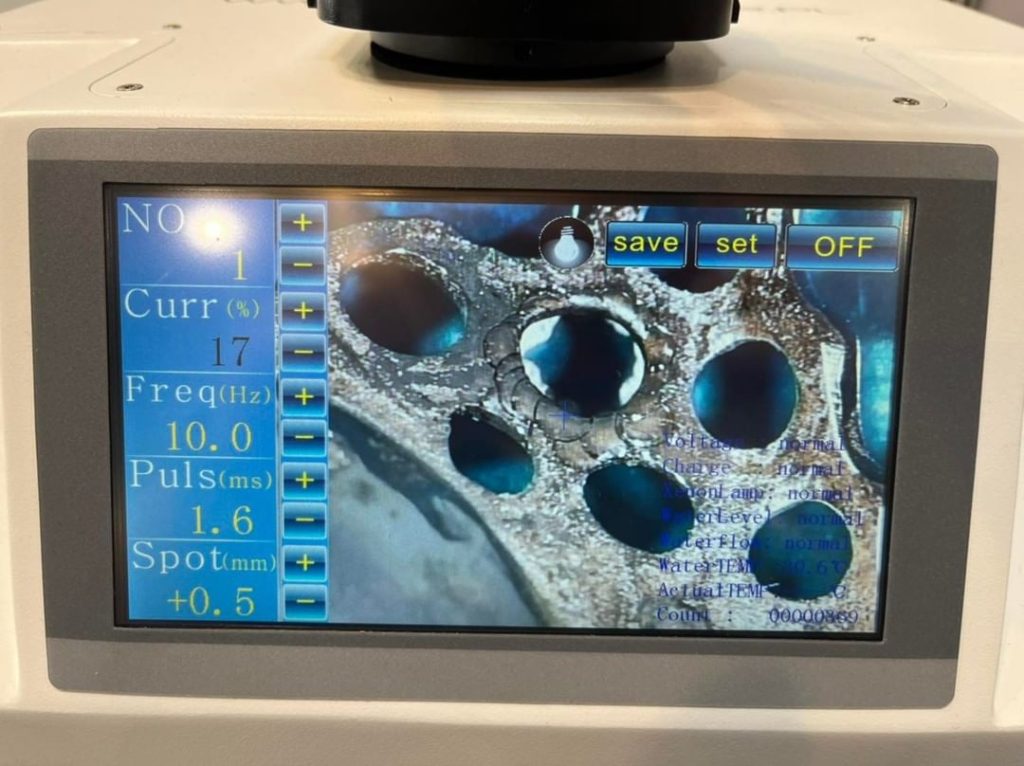
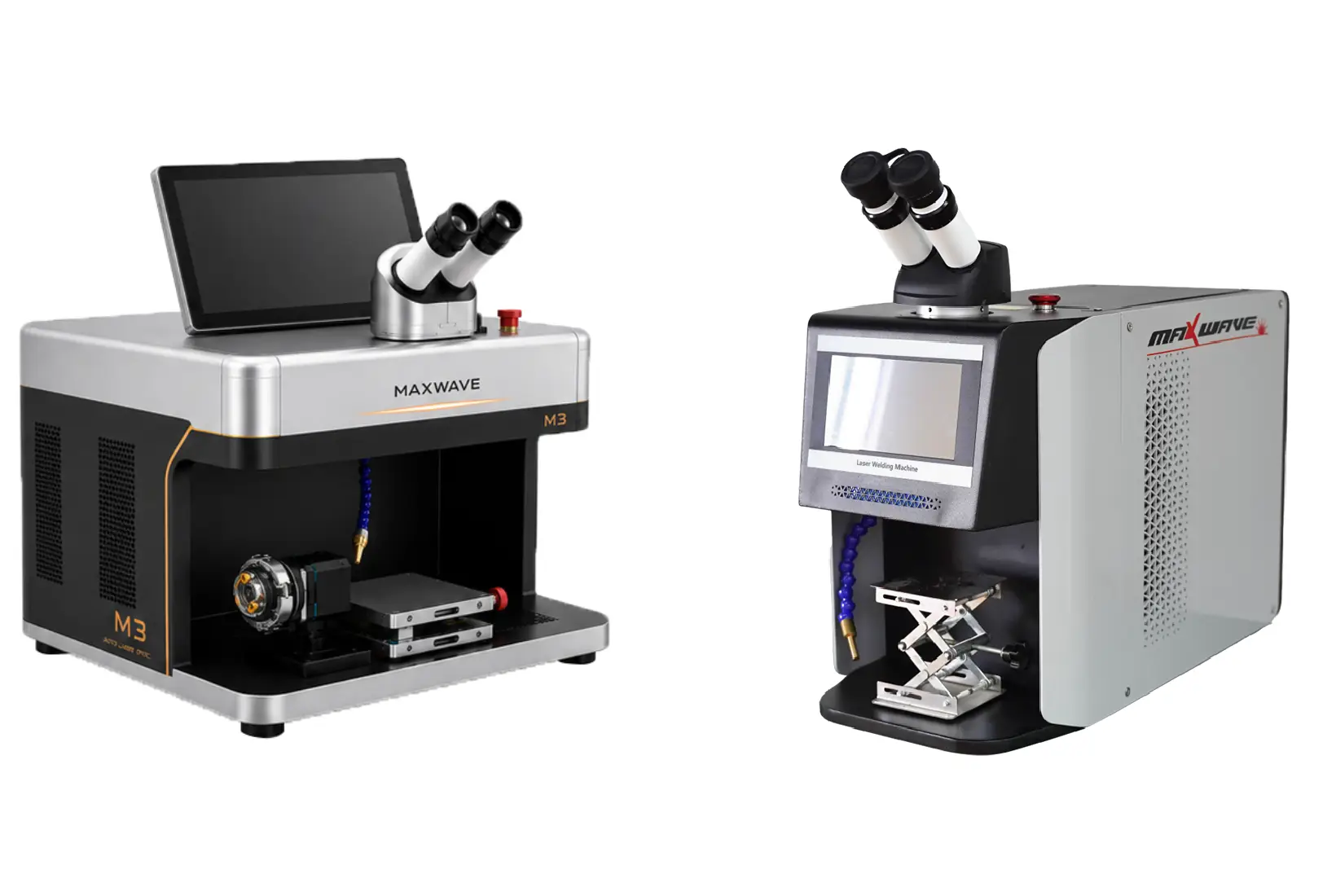
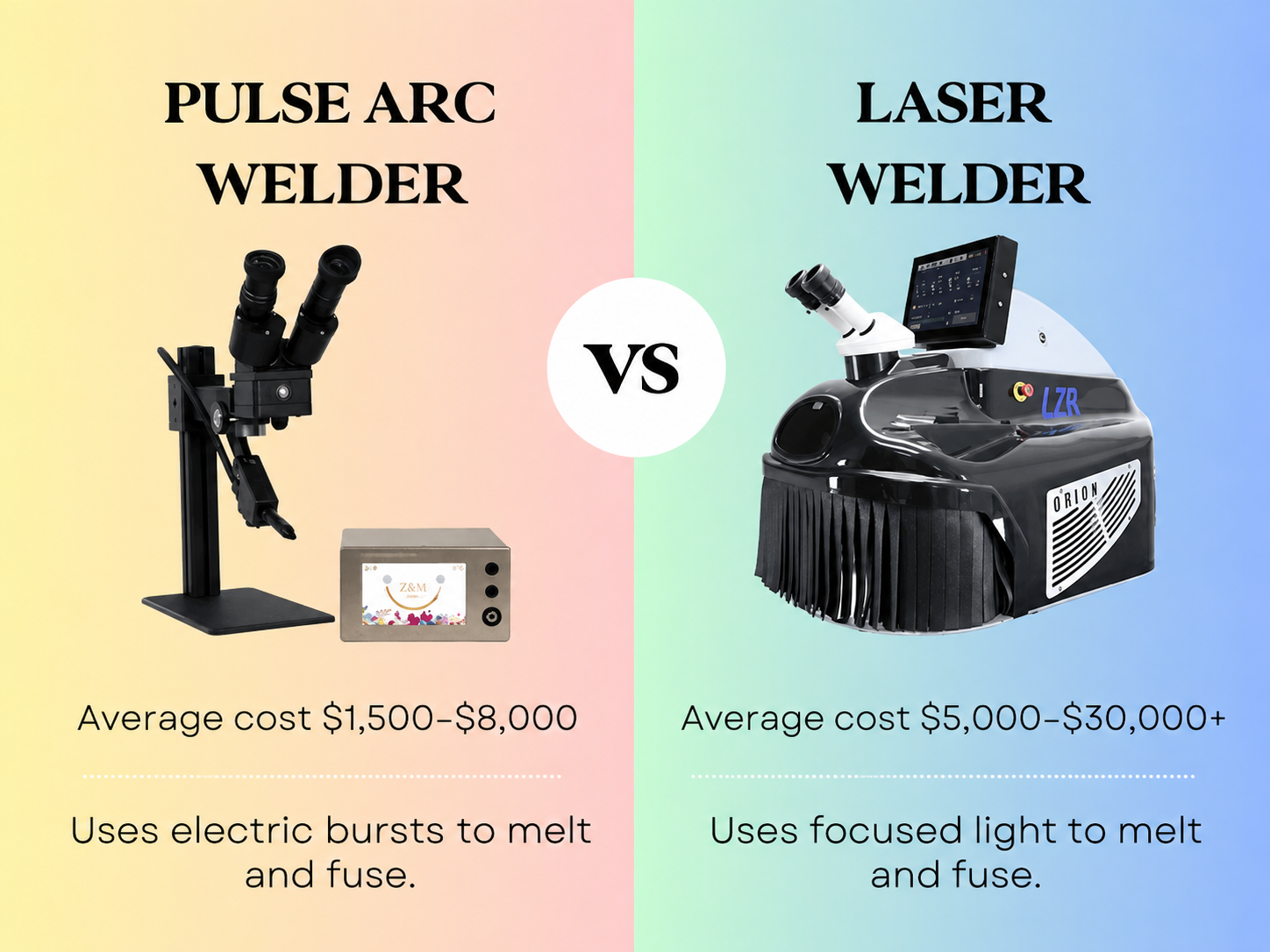
A jewelry laser welder focuses short laser pulses onto a very small area under a microscope.
The operator can usually adjust pulse energy, pulse width, frequency, and spot size.
That combination makes it possible to change from a tiny chain-link repair to a larger ring-shank weld without changing tools.
The main advantage is localization.
Only a small area around the weld needs to melt, so nearby metal receives much less heat than it would during traditional torch soldering.
This makes laser welding particularly useful when the repair involves:
Fine components, expensive stones, existing solder joints, complex geometry, platinum, antique jewelry, or areas where post-weld cleanup must remain minimal.
How Does a Pulse Arc Welder Work?
A pulse arc welder creates a short electrical arc between an electrode and the jewelry.
The arc melts a small area of metal, allowing the operator to tack, fuse, or add filler material.
Because the equipment is compact and usually less expensive than a full jewelry laser system, pulse arc welding has become popular among small jewelry studios, permanent-jewelry businesses, and bench jewelers who need a precision joining tool without investing in a larger laser workstation.
The process can be very accurate in skilled hands.
However, positioning depends heavily on the electrode and the physical relationship between the tip, joint, filler material, and surrounding jewelry.
For extremely small or stone-adjacent repairs, the narrower and more easily adjustable laser spot generally provides greater flexibility.

Which Is Better for Prong Repair?
For worn or broken prongs, jewelry laser welding usually has the advantage.
Prong rebuilding requires the operator to add metal to a very small area while preserving the surrounding setting.
A jewelry laser welder allows the jeweler to focus the pulse precisely on the worn section and build the prong gradually with matching filler wire.
This is especially valuable when the prong is close to a center stone or when several soldered joints are located nearby.
Pulse arc welding can also rebuild prongs successfully.
However, the operator needs to control the electrode position carefully and may need additional protection around the stone or adjacent structure.
For simple, accessible prongs, either technology may work well.
For small shared prongs, delicate settings, high-value stones, or complex restorations, laser generally provides the more controlled repair process.
Which Is Better for Ring Sizing?
For ordinary ring sizing, both technologies can produce strong results.
The real difference becomes more noticeable when the ring is complicated.
A plain gold band with clean joint preparation may not require the full precision advantage of a laser welder.
A pulse arc system can tack and join many standard ring repairs effectively when the operator has enough access to the joint.
Laser welding becomes more valuable when the ring contains:
Gemstones near the sizing area, engraving, multiple metals, decorative details, previous solder joints, platinum, or a thin and easily distorted shank.
Because heat is concentrated close to the seam, the jeweler may reduce discoloration and post-weld finishing.
For high-end ring repairs, that additional control can save more time after welding than it costs during the weld itself.
For simple sizing, both can work. For complex or high-value sizing, laser usually gives the cleaner workflow.
Which Is Better for Fine Chain Repair?
This is one of the clearest advantages for laser welding.
Fine chains contain very small links with little room between the target joint and the neighboring links.
Too much heat or an oversized weld can fuse several links together and make the chain rigid.
A laser welder can use a very small spot to target only the broken section.
This makes it particularly suitable for:
Fine cable chains, delicate rope chains, small jump rings, bracelet links, and miniature findings.
Pulse arc welding can also repair chains, especially heavier links.
But as the wire becomes finer and the spacing between links decreases, electrode positioning and heat control become more difficult.
For shops handling fine chain repair regularly, laser welding usually provides the greater margin for precision.
Which Is Better for Repairs Near Gemstones?
Laser welding usually provides better control around gemstone settings, but it is important not to describe any welding process as automatically “stone safe.”
A laser concentrates energy into a small weld area rather than broadly heating the entire piece.
That can reduce the amount of heat reaching the stone.
However, gemstone risk depends on much more than the machine type.
Diamonds, sapphires, rubies, emeralds, opals, pearls, treated stones, fracture-filled stones, and coated gemstones respond differently to heat, shock, and direct or reflected laser energy.
Pulse arc welding can also be used near stones, but the operator generally has less freedom to adjust the physical size of the energy spot.
Protective shielding and careful electrode positioning therefore become more important.
For high-value gemstone repairs, laser welding is usually preferred when the goal is maximum control.
But when the gemstone is particularly sensitive or unidentified, removing it may still be safer than relying on either welding method.

Which Is Better for Platinum?
Platinum is another area where laser welders for jewelry are particularly useful.
Platinum jewelry often requires more energy than comparable gold repairs, especially on heavier ring shanks and substantial prongs.
A professional laser welder gives the operator control over pulse energy, pulse width, and spot size, making it easier to build the weld gradually.
This is valuable for platinum ring sizing, prong rebuilding, porosity repair, and component assembly.
Pulse arc systems can also weld platinum depending on their design and energy capacity.
However, for shops performing platinum repair regularly, the wider operating range of a jewelry laser welder usually makes it a stronger long-term choice.
What About Gold, Silver, and Other Metals?
Gold generally works well with both technologies.
For normal yellow- and white-gold bench repairs, the decision is often driven more by repair complexity than by the metal itself.
Silver can be more demanding because it conducts heat rapidly and can require careful energy control.
The best setting also varies significantly depending on whether the piece is sterling silver, fine silver, plated material, or another alloy.
For mixed-metal or unusual repairs, laser welding generally provides more parameter flexibility.
However, neither machine can overcome incompatible metallurgy.
If two metals form a brittle or unstable joint, simply increasing the energy will not create a reliable repair.
Material compatibility still matters more than machine power.
Which Produces Less Post-Weld Cleanup?
Laser welder generally has an advantage here.
The smaller heat-affected area can mean less discoloration, less surrounding oxidation, and less metal that needs to be filed or polished after the repair.
This becomes particularly valuable on engraved rings, textured surfaces, antique jewelry, and other pieces where aggressive finishing could remove original detail.
Pulse arc repairs can also produce clean results, but the final appearance depends heavily on electrode placement, energy level, filler technique, and operator experience.
For a repair shop handling high-value pieces, reducing post-weld finishing can be just as important as reducing welding time.
Which Is Easier to Learn?
Neither technology is completely automatic.
A laser welder requires the operator to understand pulse energy, pulse width, frequency, spot size, focus, filler wire, shielding gas, and microscope positioning.
A pulse arc welder requires good electrode placement, filler control, arc positioning, and a strong understanding of how the joint responds to each pulse.
Pulse arc systems may appear simpler because they contain fewer adjustable laser parameters.
However, fine repairs can require significant manual skill.
Laser welders provide more controls, but those controls also make it easier to adapt the process once the operator understands them.
For a professional repair shop performing many different jobs, the additional adjustment range of a laser can become an advantage rather than a complication.
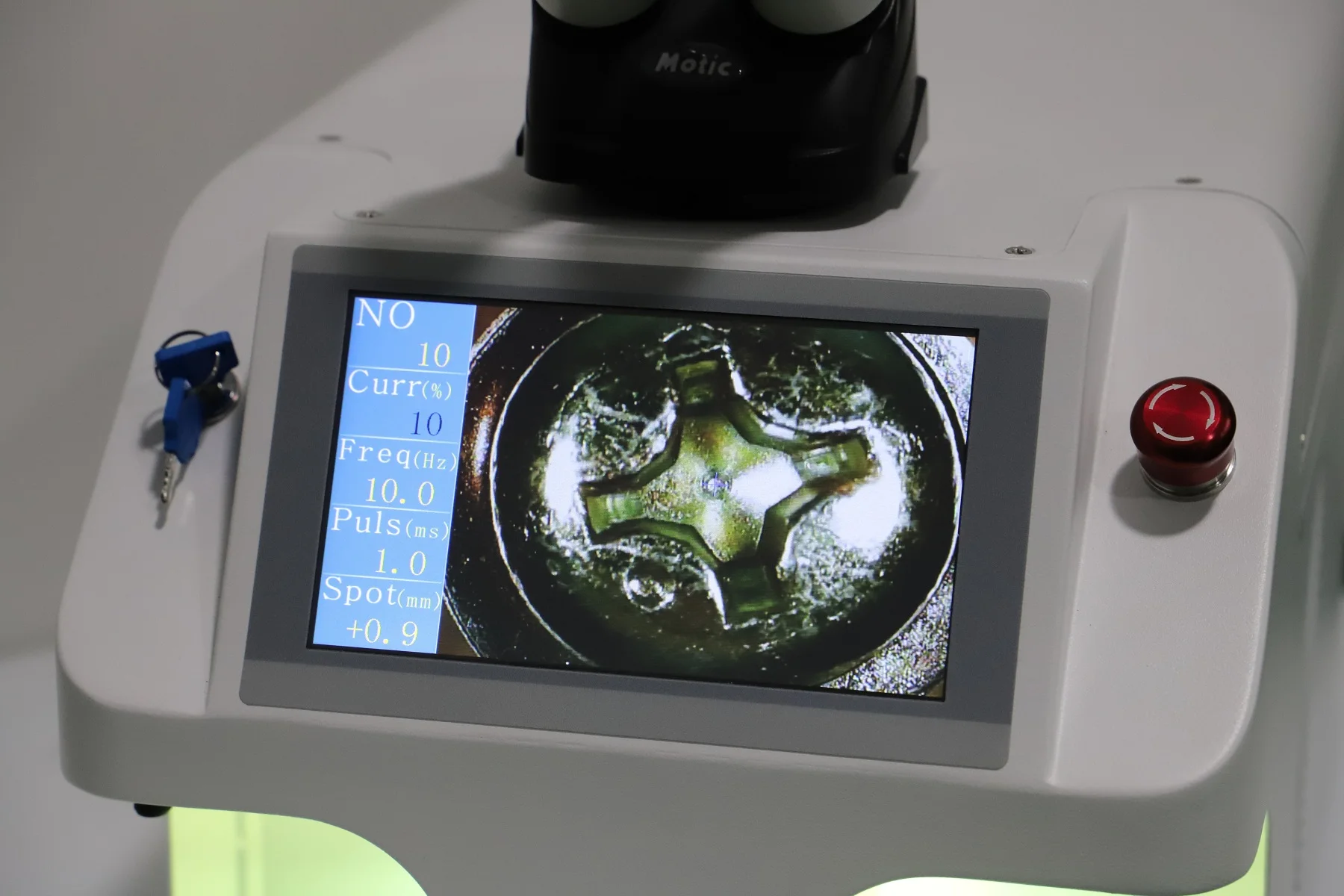
Jewelry Laser Welder vs. Pulse Arc Welder: Cost
Pulse arc welding generally has the lower entry cost.
For a small jewelry studio completing occasional repairs, this can be a major advantage.
A jewelry laser welder requires a larger investment because the complete system may include the laser source, microscope, cooling system, argon supply, control electronics, optics, and larger workstation.
But purchase price should not be evaluated alone.
A busy repair business should also consider:
Time spent finishing each repair, rework, outsourced jobs, damaged pieces, training, maintenance, spare parts, and the value of repairs that become possible after buying the machine.
A lower-cost pulse arc machine can provide excellent value when it handles the work already coming across the bench.
A higher-cost laser becomes easier to justify when precision repairs represent a meaningful share of revenue.
Which Repair Shop Should Choose a Pulse Arc Welder?
A pulse arc welder makes sense when the shop mainly handles basic bench work and wants a relatively affordable precision joining tool.
It can be a good fit for:
Small jewelry studios, permanent-jewelry businesses, occasional ring and clasp repair, jump rings, basic fabrication, and operators with lower repair volume.
It can also be a useful secondary tool in a larger workshop.
The strongest reason to choose pulse arc is not that it is “better than laser.”
It is that it may provide enough capability for the work you actually perform without requiring the larger laser investment.
Which Repair Shop Should Choose a Jewelry Laser Welder?
A jewelry laser welder becomes more attractive when repair complexity and precision increase.
It is a strong fit for shops regularly handling:
Fine chains, prong rebuilding, ring sizing near stones, platinum, antique jewelry, porosity, custom fabrication, mixed repair work, and high-value pieces where reducing heat and finishing matters.
It is also more attractive for shops bringing outsourced repair work back in-house.
For these businesses, the machine is not only replacing a joining tool.
It can expand the range of repairs the shop is willing to accept.
Quick Decision Guide
Your Main Work | Better Starting Choice |
|---|---|
Jump rings and simple attachments | Pulse Arc |
Permanent jewelry | Pulse Arc |
Basic gold repairs | Either |
Standard ring sizing | Either |
Fine chains | Laser |
Prong rebuilding | Laser |
Stone-adjacent repair | Laser |
Platinum repair | Laser |
Antique or high-value restoration | Laser |
Wide variety of professional repair work | Laser |
This table should be treated as a starting point rather than an absolute rule.
Machine quality and operator skill still matter.
What Should You Test Before Buying?
Do not choose between laser and pulse arc only from demonstration videos.
Send representative jewelry to the supplier.
Include the repair types that matter most to your business: a fine chain, worn prong, standard ring sizing joint, platinum piece, and one difficult repair located near a setting.
Compare the finished repairs for:
Joint quality, heat discoloration, porosity, amount of finishing required, ease of positioning, repeatability, and total repair time.
Also compare warranty, training, consumables, spare parts, and technical support.
The best welding technology is the one that produces better repairs on the jewelry your customers actually bring you.
Conclusion
Both jewelry laser welders and pulse arc welders can produce professional jewelry repairs.
The difference is primarily one of control, application range, and investment.
A pulse arc welder is a practical and affordable choice for jump rings, simple attachments, permanent jewelry, and many basic bench repairs.
A jewelry laser welder provides a wider process window for fine chains, prongs, platinum, complex ring sizing, stone-adjacent work, and high-value restoration.
For an occasional repair bench, pulse arc may provide all the capability required.
For an active professional repair shop handling delicate and varied work, laser welding generally delivers the stronger combination of precision, flexibility, and repair quality.
Do not make the decision based only on machine price.
Make it based on the repairs you want to accept.
Send JewelryLaserNova photos or samples of your typical repair work, including the metals, joint types, and most difficult applications. The team can arrange sample laser welding and help you determine whether a professional jewelry laser welder provides a meaningful advantage over pulse arc for your actual bench work.