A used jewelry laser welder can look extremely attractive when it costs thousands of dollars less than a new machine.
But the lower purchase price does not automatically make it the better investment.
For most professional jewelry repair shops, a new jewelry laser welder is usually the safer long-term choice because it comes with a known operating history, warranty coverage, current components, training, and more predictable technical support.
A used machine can still offer excellent value when the discount is substantial and you can verify its condition before buying.
The decision comes down to four questions:
How much money are you actually saving?
How important is the welder to daily revenue?
Can you verify the condition of the used machine?
How expensive would unexpected downtime be?
The better investment is not necessarily the cheaper machine. It is the machine that gives your workshop the best combination of purchase cost, reliability, support, and usable service life.
New vs Used Jewelry Laser Welder: What Really Changes?
The most obvious difference is purchase price, but that is only part of the comparison.
Factor | New Machine | Used Machine |
|---|---|---|
Purchase price | Higher | Lower |
Warranty | Usually included | Limited or none |
Machine history | Known | Must be verified |
Unexpected repair risk | Lower | Higher |
Training | Usually available | Depends on seller |
Spare-parts support | Easier to confirm | May become difficult |
Software access | Current and supported | Must verify transfer |
Downtime predictability | Better | Less predictable |
Best for | Active professional workshops | Experienced, budget-focused buyers |
The real advantage of buying new is therefore predictability.
You know the machine has not spent years running in another workshop. You know when the warranty begins. You know which components are installed and who is responsible for technical support.
With a used machine, the lower price compensates you for accepting more uncertainty.
That uncertainty is not necessarily a problem if the equipment has complete service records and can be tested properly.
It becomes a problem when the buyer is relying mainly on the seller's statement that:
“The machine works perfectly.”
Why New Machines Cost More
A new jewelry laser welding machine usually includes more than untouched hardware.
Depending on the supplier, the purchase may also include operator training, installation guidance, warranty coverage, sample welding, technical support, manuals, spare parts, and access to current software.
For a first-time buyer, these services can be particularly valuable.
Learning how to control pulse energy, pulse width, frequency, spot size, argon shielding, focus, and filler wire takes time.
A machine without training may be cheaper on purchase day but slower to become productive.
Why Used Machines Can Still Be Attractive
The biggest advantage of used equipment is simple:
You can acquire more machine for less capital.
A professional system that was expensive when new may become affordable after several years of depreciation.
This can be particularly attractive for a solo jeweler or low-volume workshop that wants laser capability but cannot yet justify the cost of a new premium system.
The key is making sure the previous owner has not already consumed most of the value you are trying to buy.
Compare Total Ownership Cost, Not Just the Purchase Price
A common mistake is comparing:
$6,000 new machine vs $3,500 used machine
and assuming the used machine saves $2,500.
That calculation is incomplete.
A better comparison is:
Total Ownership Cost = Purchase Price + Maintenance + Repairs + Downtime + Financing – Resale Value
You do not need to predict every future repair exactly.
The purpose of the calculation is simply to account for costs that are invisible in the initial quotation.
New Machine Cost Structure
A new machine normally starts with a higher capital investment but offers:
Lower early repair risk.
Warranty coverage.
Known component condition.
Current software.
Training.
Better access to technical support.
More predictable spare-parts availability.
For a business using the welder every day, those benefits have real financial value.
Used Machine Cost Structure
A used machine starts with lower capital cost but introduces more uncertainty.
Possible additional costs include:
Immediate servicing.
Replacement optics.
Cooling-system repairs.
Electrical components.
Control boards.
Laser-source or lamp-related components depending on machine design.
Software reactivation.
Unexpected downtime.
The important question is therefore not:
“How much cheaper is the used machine?”
It is:
“How much of that saving will remain if I have to repair it during the first two years?”
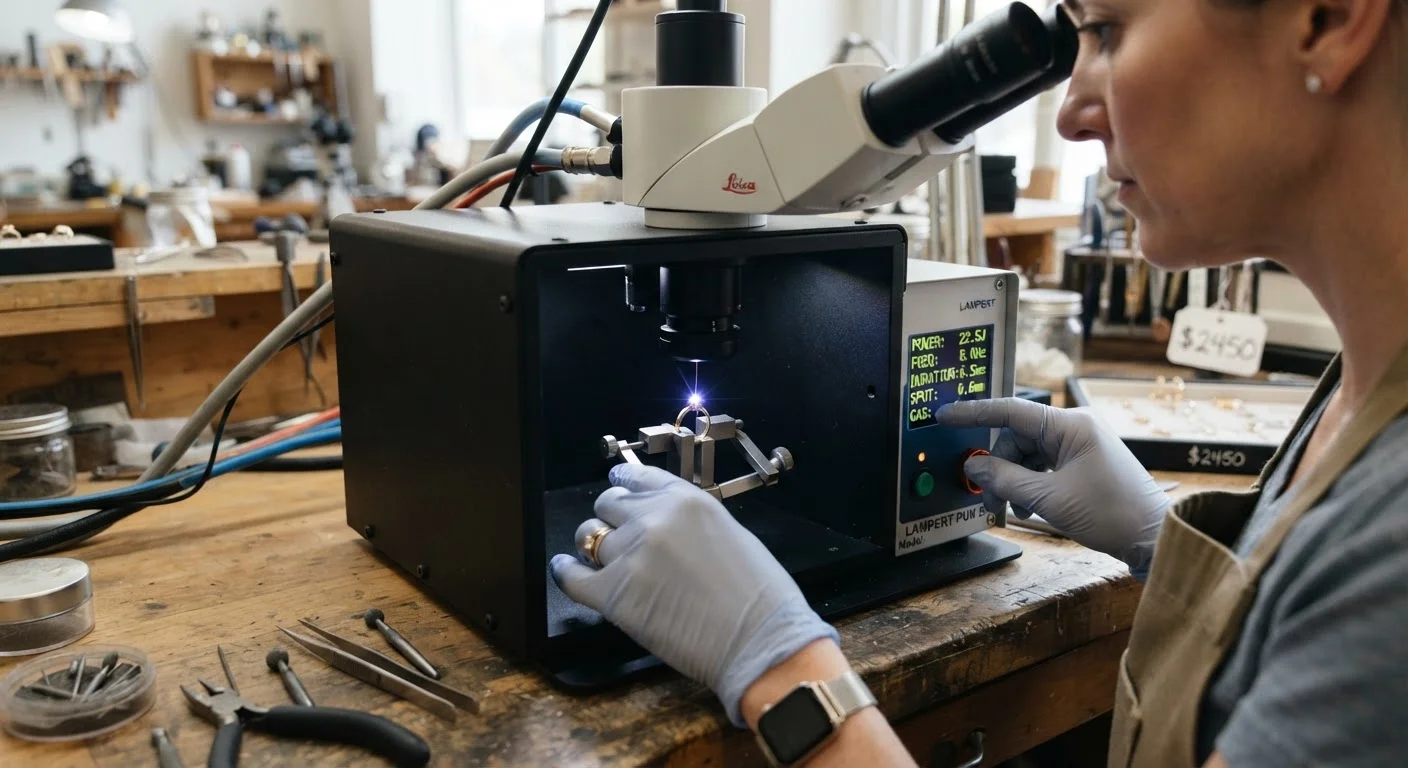
A $3,000 saving can disappear quickly if one major repair is followed by several weeks of downtime.
Downtime Can Matter More Than Repair Cost
This is especially important for active jewelry repair shops.
If you rely on jewelry laser welding for ring sizing, prong rebuilding, chain repair, porosity filling, and custom work, a machine failure affects more than maintenance expenses.
You may also have to:
Outsource jobs.
Delay customer orders.
Return to slower soldering processes.
Pay additional shipping.
Reject certain repairs.
Spend employee time troubleshooting.
For a busy shop, the lost revenue from downtime can exceed the cost of the replacement component itself.
This is why new machines generally become more attractive as utilization increases.
The more often the machine makes money, the more valuable reliability becomes.
How to Decide Whether a Used Machine Is Actually Worth Buying
A used laser welder should never be purchased on price alone.
The strongest used equipment purchase usually has four characteristics:
A known model, documented maintenance history, current manufacturer support, and successful live testing.
If one of those is missing, the discount needs to be significantly larger to justify the risk.
Verify the Exact Machine
Start with the model, serial number, manufacturing year, rated power, and original manufacturer.
Then contact the manufacturer or distributor if possible.
Confirm whether the exact model is still supported.
This matters because an older machine may work perfectly today but become difficult to repair if a proprietary component fails next year.
Before purchasing a used laser welder for jewelry, confirm that you can still obtain critical components and technical support.
Ask for Service Records
Do not accept “lightly used” as a maintenance history.
Ask for documentation showing:
How long the machine has been used.
What major repairs have been completed.
Which components have been replaced.
Whether the cooling system has been serviced.
Whether recurring faults have occurred.
Why the owner is selling the machine.
A machine with five years of documented maintenance can be a safer purchase than a two-year-old machine with no records at all.
Inspect Cooling, Optics, and Controls
The machine should be tested while running—not only inspected while switched off.
Check whether the cooling system remains stable during repeated welding.
Look for leaks, unusual pump noise, warnings, or unstable temperature.
Inspect the microscope and protective optics for obvious damage, contamination, or poor alignment.
Test the controls and confirm that important parameters can still be adjusted normally.
The machine should respond consistently to changes in pulse energy, pulse width, frequency, spot size, focus, argon flow, and foot-pedal activation where applicable.
Perform Repeated Welds
One successful pulse proves very little.
Ask the seller to perform multiple welds under realistic conditions.
Look for consistency.
Does the weld quality remain stable as the machine warms up?
Does the output weaken?
Does the cooling system remain stable?
Do alarms appear after repeated operation?
A commercial laser welder needs repeatability, not simply the ability to fire.
Bring Your Own Jewelry
This is one of the best ways to evaluate a used machine.
Take samples representative of your normal work:
A fine gold chain.
A worn prong.
A normal gold ring shank.
A silver part.
A platinum piece if platinum is important to your workshop.
Test both delicate and heavier repairs.
Evaluate weld control, penetration, discoloration, consistency, finishing requirements, and the ability to work at small spot sizes.
If the machine cannot perform your actual repairs during the inspection, its original specifications do not matter.
Confirm Software and Spare Parts
Used industrial equipment sometimes has a hidden problem:
The hardware works, but the software cannot be transferred.
Before paying, confirm that you will receive all necessary control software, installation files, passwords, licenses, manuals, and parameter backups.
Also verify that replacement components are still available.
An older laser welder can remain productive for years when parts are supported.
The same machine can become nearly worthless when one obsolete control board fails.

Which Is the Better Investment for Your Workshop?
There is no single answer for every jewelry business.
Your workload should determine how much risk makes sense.
Solo Jeweler or Low-Volume Repair Bench
A used machine can make good financial sense here.
If laser welding is used only occasionally and several days of downtime would not significantly affect the business, lowering the initial investment may be more important than having maximum warranty protection.
The best candidate is a well-maintained machine from a known seller, ideally with service documentation and current manufacturer support.
However, first-time laser users should still consider the value of training.
A cheap machine is not a bargain if it takes months to learn how to use it effectively.
Active Jewelry Repair Shop
For most active repair businesses, new equipment usually offers the stronger balance.
These shops may use the laser for:
Ring sizing.
Prong rebuilding.
Chain repair.
Porosity filling.
Stone-adjacent repairs.
Custom alterations.
The welder becomes part of daily revenue generation.
In this situation, warranty, technical support, parts availability, and reduced downtime risk become more important than maximizing the initial discount.
Custom Jewelry Studio
The answer depends heavily on workload.
A studio doing low-volume, high-value custom work may successfully use a quality secondhand machine.
But the machine still needs enough flexibility for different gold alloys, silver, platinum, fine spot work, and larger assembly jobs.
For custom work, capability and control matter more than simply owning the newest machine.
High-Volume Workshop or Jewelry Manufacturer
New equipment generally makes more sense.
Production environments should prioritize:
Uptime.
Cooling stability.
Repeatable output.
Current spare parts.
Technical support.
Operator training.
Warranty.
Consistency between shifts.
At high utilization, one long period of downtime can cost far more than the money saved by purchasing used equipment.
For production workshops, reliability is part of ROI.
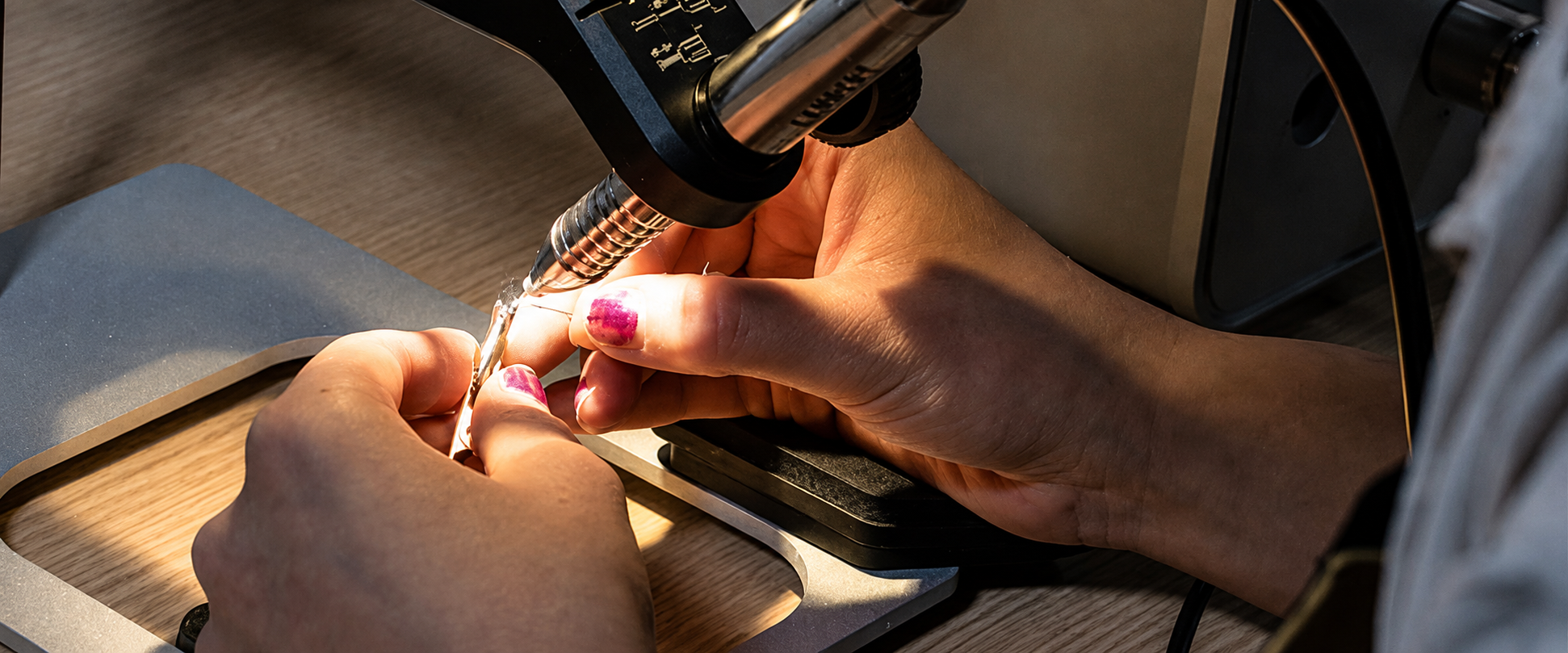
Is a Demo or Refurbished Jewelry Laser Welder a Better Compromise?
There is a useful middle ground between completely new and privately used equipment.
Demo, showroom, and professionally refurbished machines can sometimes provide the best combination of lower price and reduced risk.
A good refurbished system may still include:
Supplier inspection.
Known operating history.
Current technical support.
Training.
Replacement parts.
A limited warranty.
This can be especially attractive for buyers who want to reduce capital investment but are uncomfortable purchasing an unknown machine from a private seller.
However, the word “refurbished” should not automatically increase trust.
Ask exactly what was refurbished.
Was the cooling system serviced?
Were worn optics replaced?
Was output tested?
Were electrical components inspected?
Does the machine come with a warranty?
A machine that was simply cleaned and repainted is not professionally refurbished.
A Simple New vs Used Decision Checklist
Choose new when the machine will be used daily, downtime would immediately affect customer orders, you need structured training, you want warranty protection, or this is your first jewelry laser welder.
Consider used when the price difference is substantial, the exact model is still supported, complete maintenance records are available, you can inspect and test the machine, and your workshop can tolerate some repair risk.
Consider demo or refurbished when you want to reduce upfront cost but still value supplier support and some warranty protection.
The decision becomes much easier when you stop asking:
“Which machine costs less?”
and start asking:
“Which machine gives me the lowest business risk for the amount I am investing?”
Conclusion
New and used jewelry laser welders can both be good investments.
The difference is primarily cost versus predictability.
A new machine requires more upfront capital but normally gives you a known operating history, warranty protection, training, current hardware, better parts availability, and lower early ownership risk.
A used machine can reduce the initial investment significantly, but the saving only matters when the equipment has enough reliable service life remaining to justify the risk.
For most first-time buyers, busy repair shops, and production environments, a new professional jewelry laser welder is usually the more predictable long-term investment.
For experienced jewelers with lower utilization, technical knowledge, and access to a well-maintained machine with complete records, used equipment can offer excellent value.
The most important rule is simple:
Do not buy new simply because it feels safer, and do not buy used simply because it looks cheaper. Compare the total ownership cost, downtime risk, remaining machine value, and support available after the sale.
Considering a new professional jewelry laser welder for your workshop?
Send JewelryLaserNova your typical repair types, metals, expected workload, current process, and budget. The team can perform sample welding, recommend a suitable configuration, and provide an itemized quotation covering the machine, training, warranty, and spare-parts support—giving you a realistic benchmark to compare against any used machine you are considering.