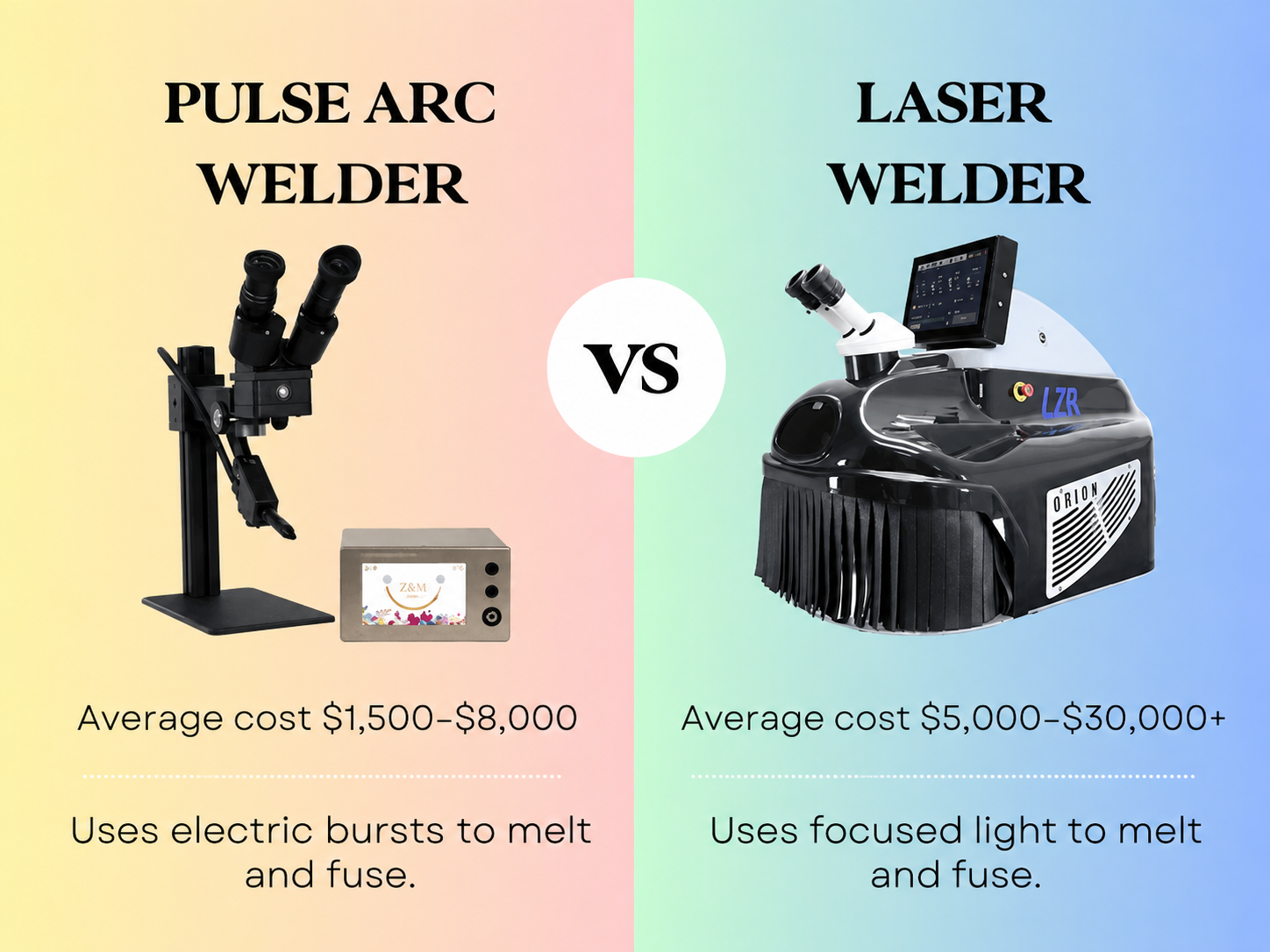
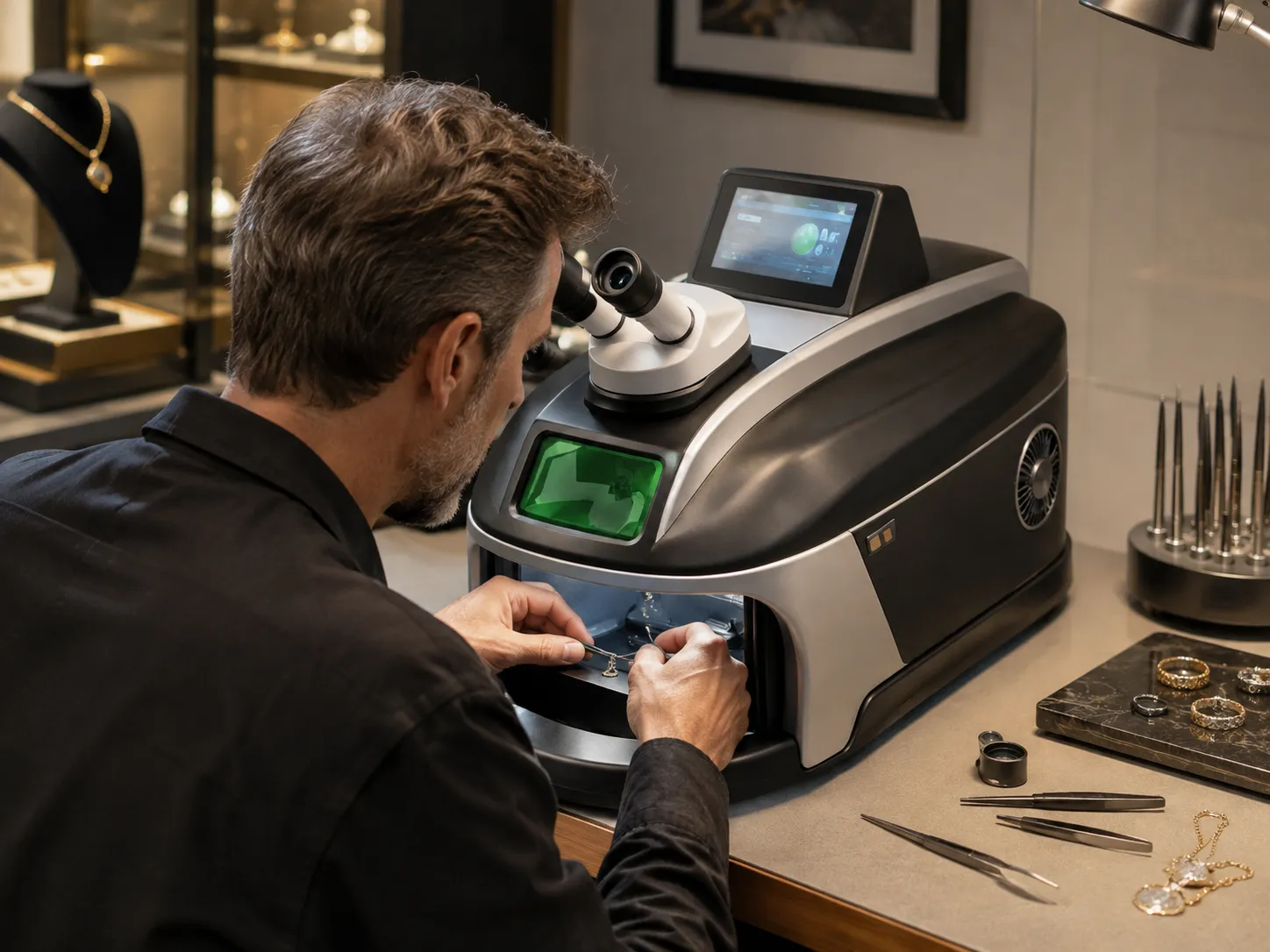
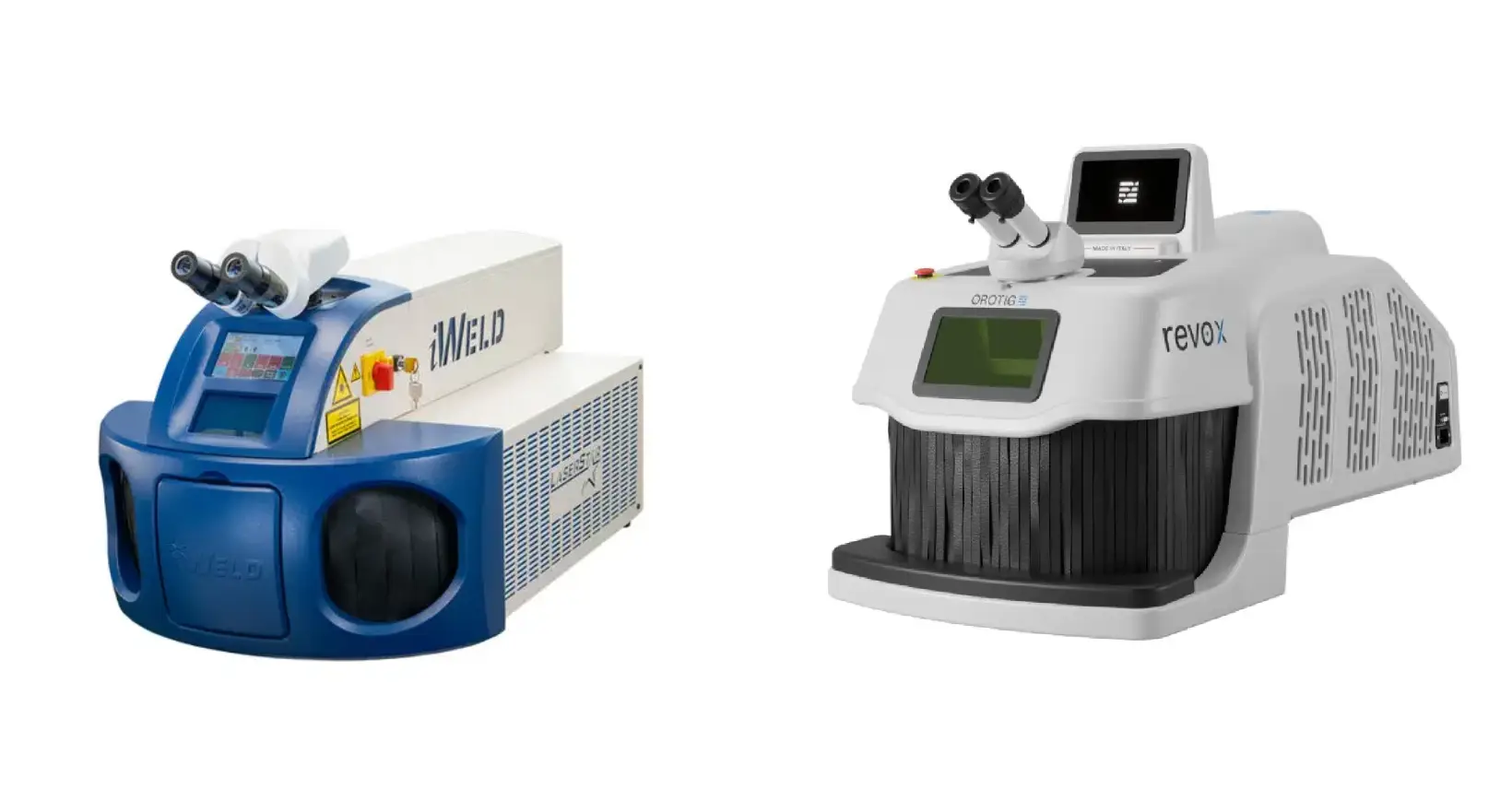
LaserStar and Orotig are both established names in professional jewelry laser welding, but they are not identical choices.
LaserStar's iWeld platform focuses heavily on jewelry repair and bench welding, with benchtop and professional configurations, multiple power levels, dedicated jewelry training, and U.S.-based technical support. LaserStar currently lists the iWeld in 35W, 60W, and 80W versions, with platforms spanning approximately 40–150 J depending on configuration.
Orotig takes a broader product-line approach. Its current jewelry range extends from the compact Midi Tech and Evo White through the Evo X and Evo X Tech to the Revo X for intensive production. The Evo X, for example, combines a 90W average output, up to 9 kW peak power, 0.1–2 mm focal diameter, liquid cooling, touchscreen presets, and remote-assistance connectivity.
So which is better?
Choose LaserStar if your workshop puts a high value on a proven jewelry-repair platform, hands-on training, and particularly strong U.S.-based service infrastructure.
Choose Orotig if you prioritize modern parameter assistance, reflective-metal capability, operator-friendly controls, or need a product range that can scale from a small repair bench to intensive jewelry production.
For most buyers, the decision should come down to the specific model, repair mix, workload, operator experience, and support available in your region—not the brand name alone.
LaserStar vs Orotig: Power, Precision and Everyday Jewelry Repair
The first mistake when comparing these brands is looking only at watts.
For jewelry work, pulse energy, spot-size range, pulse control, microscope quality, cooling, and ease of parameter adjustment can matter just as much as average power.
A higher-powered machine is not automatically better for fine chain repair, prong rebuilding, porosity filling, or work close to gemstones.
Quick Comparison
Factor | LaserStar iWeld | Orotig Evo White / Evo X | Practical Difference |
|---|---|---|---|
Main positioning | Jewelry repair and professional bench welding | Repair through higher-volume jewelry production | Both cover professional jewelry work |
Power options | Multiple iWeld configurations, currently 35W–80W | Evo White 75W; Evo X 90W | Compare pulse capacity, not watts alone |
Pulse energy | iWeld family available across roughly 40–150 J configurations | Evo White 160 J; higher Orotig models extend further | Orotig offers more capacity as you move up the range |
Spot control | Fine jewelry-oriented beam control | Evo X 0.1–2 mm; Evo White 0.15–1.5 mm | Both cover fine and broader jewelry work |
Cooling | Self-contained water-cooling architecture on iWeld systems | Liquid cooling on Evo White and Evo X | Suitable for professional bench use |
Interface | Traditional jewelry-oriented controls and memory functions | Touchscreen, presets, EnergyTune/parameter assistance on current models | Orotig is stronger on guided operation |
Training | Dedicated jewelry welding workshops and online resources | Training, preset programs, video library and remote support | Both offer structured operator support |
Service strength | Particularly strong U.S. infrastructure | International partner network + remote support | Location can decide the better choice |
LaserStar's iWeld Jewelers' Edition has been developed specifically around jewelry applications, with jewelry presets and memory functions alongside its benchtop architecture. LaserStar also promotes the system for silver and other difficult alloys.
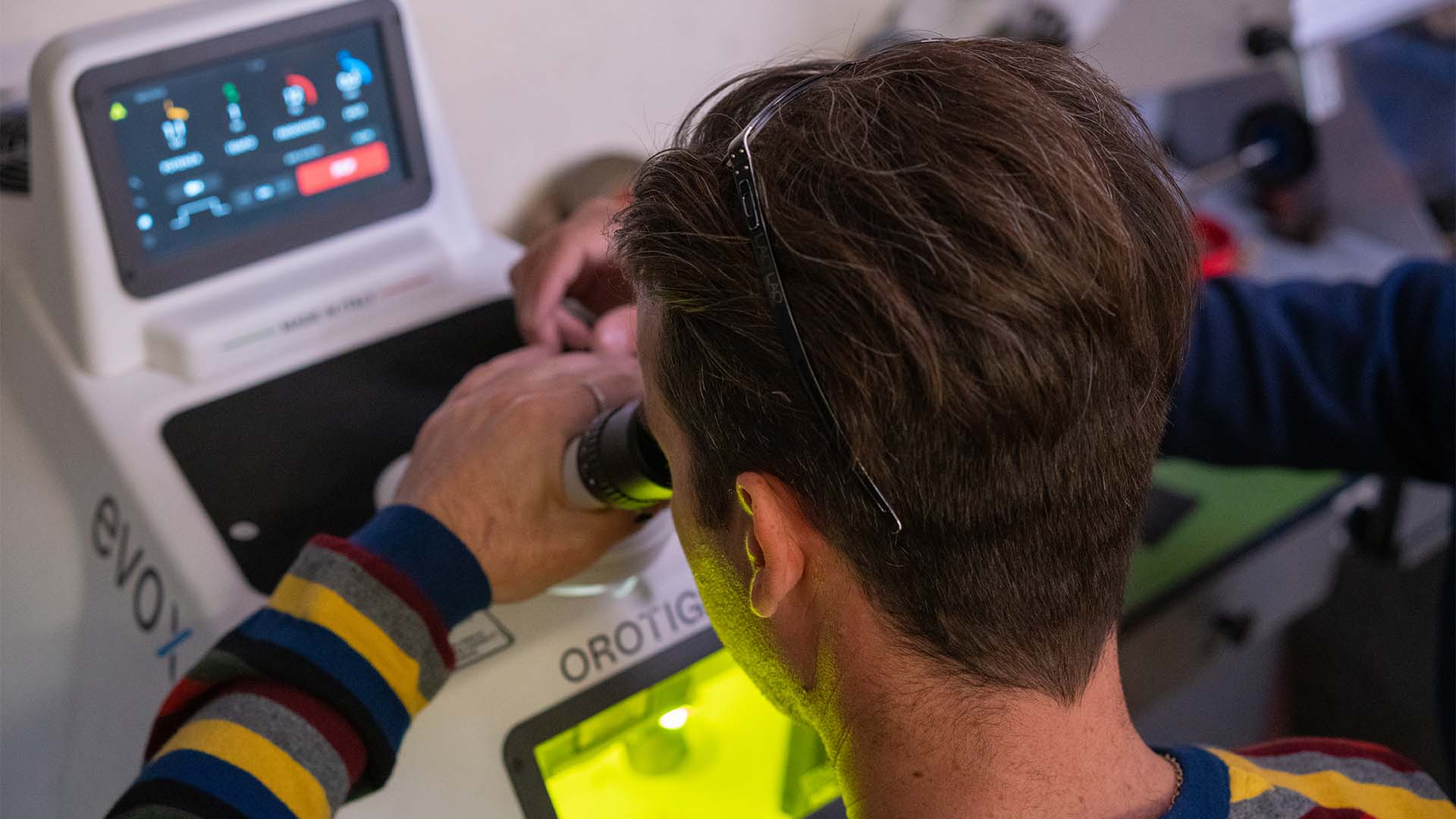
Orotig places more emphasis on guided parameter control. Evo White's EnergyTune system automatically adjusts power and pulse duration according to the selected metal and spot diameter, while Evo X provides a 7-inch touchscreen, material/process presets, and the ability to save customized parameters.
That difference matters when several people use the same machine.
An experienced goldsmith may prefer direct control and already know how to move between settings.
A retail jewelry store training additional operators may place more value on presets and guided adjustments that shorten the learning curve.
This is why comparing a professional jewelry laser welder should go beyond headline power.
For experienced bench jewelers: both platforms provide the control needed for professional work.
For shops training multiple or less-experienced operators: Orotig's current interface and preset philosophy can be particularly attractive.
Gold, Silver and Platinum
Both brands target precious-metal applications, including jewelry repair and manufacturing.
LaserStar specifically promotes iWeld for silver as well as jewelry repair tasks such as ring sizing, chain repair, prong work, porosity repair, and assembly.
Orotig explicitly designs its current Evo X platform for reflective materials including white gold, silver, and platinum, while the newer Evo X Tech adds its SoftSpot technology and up to 250 J / 10 kW peak capability for demanding work.
For a typical gold repair shop, either brand can be appropriate.
The difference becomes more interesting when silver, white gold, platinum, heavy shanks, or varied custom manufacturing represent a substantial part of the workload.
In that situation, do not choose from the brochure.
Ask both suppliers to weld the same samples.
A good comparison set would include:
A fine gold chain, a worn prong, an 18K ring shank, a silver component, and a platinum section.
Judge the result by weld control, penetration, surface finish, repeatability, and how much finishing is required afterward.
A real sample test tells you far more than comparing wattage.
Which Feels Better in a Real Jewelry Workshop?
This is where LaserStar vs Orotig becomes less about specifications and more about workflow.
A laser welder for jewelry repair may be used for hours every week, so microscope quality, hand position, chamber access, parameter changes, lighting, and operator comfort can affect productivity every day.
LaserStar: Traditional Professional Bench Workflow
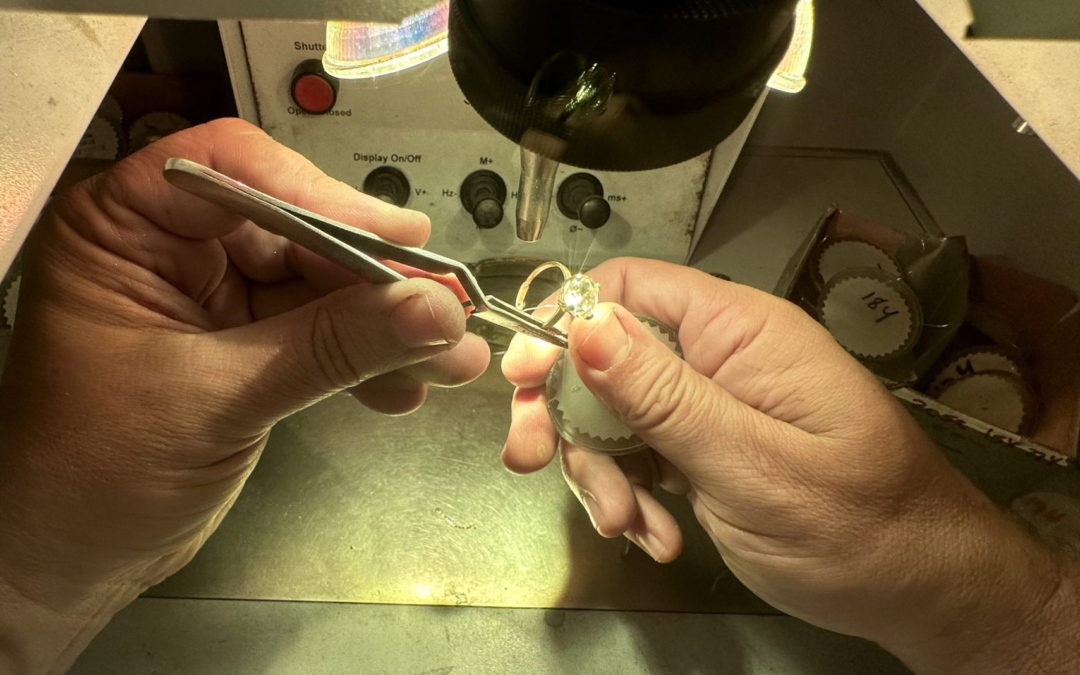
LaserStar's manual welding systems are built around the jeweler positioning the workpiece by hand inside the chamber while observing the weld through a stereo microscope with a crosshair. This free-moving approach is designed for precision repair and assembly work without complex fixturing.
That makes the platform particularly logical for repair benches handling a varied stream of one-off jobs.
Ring sizing.
Chain repair.
Prong rebuilding.
Porosity.
Earring posts.
Bracelets.
Custom assembly.
The operator remains central to the process.
For an experienced goldsmith who already knows how to adjust energy and spot behavior, that direct workflow can be very comfortable.
Orotig: More Guided and Digitally Assisted
Orotig's latest machines put more information directly in front of the operator.
Evo X uses a 7-inch IPS display with a metal/process matrix, presets, saved programs, real-time machine monitoring, and an included video library. It also supports Ethernet and Wi-Fi connectivity for remote assistance.
Evo White goes further toward guided setup through EnergyTune, where the operator selects the material and the system adjusts power and pulse duration in relation to the spot setting.
This does not replace goldsmithing skill.
It reduces the amount of parameter knowledge a new operator needs before getting close to a workable starting point.
That makes Orotig especially interesting for:
Retail jewelry stores bringing repairs in-house.
Workshops with multiple operators.
Businesses training junior bench jewelers.
Companies trying to standardize settings between users.
Workspace and Ergonomics
Orotig publishes working-chamber volumes of 25.5 liters for Evo White and 27.2 liters for Evo X, together with adjustable LED lighting and ergonomic support features.
LaserStar emphasizes compact benchtop and professional versions of the iWeld, so buyers can choose between a space-saving bench system and a larger professional platform.
There is no universal winner here.
A small retail repair room may prioritize footprint.
A custom studio handling bracelets, watch components, larger assemblies, or unusual jewelry forms may care much more about chamber access.
Before buying, sit at the machine if possible.
Put your hands where they would actually sit for two hours.
Look through the microscope.
Move a ring, bracelet, and larger component through the work area.
Ergonomics is difficult to judge from a specification sheet but becomes obvious once the machine is in daily use.
Purchase Cost Matters—But Support and Downtime Matter More
The original article put heavy emphasis on fixed three-year cost figures, but those numbers can become misleading because current pricing varies by model, country, distributor, accessories, training package, and service agreement.
A better comparison is total ownership structure:
Total Ownership Cost = Machine + Training + Maintenance + Parts + Downtime – Resale Value
This is more useful than trying to declare one brand permanently cheaper.
For a professional workshop, downtime deserves particular attention.
If the welder handles repairs every day, one week without it can mean delayed orders, outsourced work, additional shipping, or jobs being moved back to slower processes.
LaserStar Support
LaserStar currently operates technical support through phone, email, video assistance, and in-person service. Its current service documentation also shows a U.S.-based service structure, while its education platform includes LaserStar Academy, training videos, and advanced jewelry laser-welding workshops.
For buyers located in the United States, this is one of LaserStar's strongest practical advantages.
There is one detail worth knowing: LaserStar changed its service model in June 2025 to appointment-based support, and non-warranty phone/video assistance can now be billable. Older machines may also require certain evaluations at its Orlando facility.
So buyers should ask for current warranty and service terms rather than assuming all remote support is permanently free.
Orotig Support
Orotig also has a substantial support structure.
The company provides installation/configuration support, operator training, onsite and remote assistance through Ethernet/Wi-Fi-capable machines, and an international network of specialized partners. Orotig also states that spare parts are supplied for up to 10 years after purchase.
That makes the comparison more balanced than simply saying:
“LaserStar has support; Orotig does not.”
The real question is geographical.
If you are in the U.S., LaserStar's domestic infrastructure can be a major advantage.
If you operate internationally, compare the actual Orotig partner and LaserStar service resources available in your country before deciding.
When evaluating either brand—or another jewelry laser welding machine for gold and platinum—ask for:
Warranty coverage.
Training included with purchase.
Remote-support terms.
Local or regional technician availability.
Critical spare-parts availability.
Estimated parts shipping process.
Out-of-warranty service charges.
Support for the machine five or more years later.
The answers may be more important to ROI than a small difference in purchase price.
Which Is Better for Your Workshop?
This is where the comparison becomes much simpler.
Solo Repair Shop
For a solo jeweler, either brand can work well.
LaserStar is particularly attractive for a U.S.-based goldsmith who wants an established jewelry-specific bench platform and access to domestic service and advanced jewelry training.
Orotig Midi Tech or Evo White can be more attractive to a buyer who values compact dimensions and guided parameter selection. Orotig itself positions Midi Tech for small-scale repairs and Evo White for small workshops performing more regular repair and customization work.
Best decision: compare the specific iWeld configuration against Midi Tech or Evo White—not LaserStar against the entire Orotig range.
Busy Jewelry Repair Shop
For a shop handling rings, prongs, chains, silver, platinum, and custom work throughout the day, both brands become strong candidates.
LaserStar's advantage is the mature jewelry-oriented workflow and training/support ecosystem.
Orotig Evo X's advantage is its broader guided control system, 0.1–2 mm spot range, presets, remote connectivity, and explicit optimization for reflective metals such as white gold, silver, and platinum.
For a shop with multiple operators, I would place more weight on how quickly different jewelers can reproduce a good setting than on a small difference in maximum power.
High-Volume Jewelry Manufacturing
This is where Orotig currently has the clearer product ladder.
Orotig's Revo X is specifically positioned for intensive production and is rated by the manufacturer for up to 15 hours of continuous laser welding, while Evo X Tech introduces an optimized duty cycle and higher pulse capability below it in the range.
LaserStar also offers professional welding platforms, but if your purchasing question is specifically about long continuous jewelry-production cycles, Orotig currently presents the more explicitly production-oriented progression within its jewelry lineup.
Simple Recommendation
Your Workshop | Better Starting Point |
|---|---|
U.S. solo repair shop | LaserStar iWeld deserves strong consideration |
Small shop wanting guided operation | Orotig Midi Tech / Evo White |
Mixed professional gold, silver and platinum repair | Compare LaserStar iWeld vs Orotig Evo X directly |
Multiple operators | Orotig's preset/interface system is particularly attractive |
High-volume production | Orotig Evo X Tech / Revo X |
Buyer prioritizing U.S. training/service | LaserStar |
International buyer | Compare actual local distributor/support coverage |
The important point is that LaserStar vs Orotig is not one machine against one machine.
Both brands offer different platforms.
Your shortlist should compare models at the same workload level.
The same applies when considering a more affordable desktop jewelry laser welder for a professional workshop: compare pulse range, spot control, microscope, cooling, sample-weld results, training, warranty, and spare-parts support using the same checklist.
That gives you a fair benchmark instead of paying for a brand name without knowing what capability you actually need.
Conclusion
LaserStar and Orotig are both credible professional choices, but they suit different buying priorities.
LaserStar is particularly compelling for U.S.-based jewelry repair shops that value a mature iWeld platform, jewelry-specific education, and domestic service infrastructure.
Orotig is particularly compelling for workshops that value modern touchscreen controls, preset-assisted operation, strong capability on reflective precious metals, and a product line that scales from small repair shops to intensive production.
For a solo jeweler, the decision may come down to ergonomics, local support, and price.
For a busy repair shop, compare repeatability, operator training, silver/platinum performance, and downtime support.
For a production environment, cooling capacity and continuous-duty capability become much more important.
Most importantly, do not select either brand from specifications alone.
Send both suppliers the same gold, silver, and platinum samples and ask them to perform the repairs your workshop handles most often.
Then compare:
Weld quality.
Ease of operation.
Finishing required.
Training.
Warranty.
Service access.
And the complete quotation.
The better jewelry laser welder is the one that fits your actual bench—not the one that wins the most specification categories.
If you also want a factory-direct benchmark before choosing between LaserStar and Orotig, compare them against a jewelry laser welder for professional repair shops with the same application requirements.
Send JewelryLaserNova your typical repair samples, metals, expected workload, and the LaserStar or Orotig configuration you are considering. The team can perform sample welding and provide a comparable machine configuration, giving you another data point on weld quality, specifications, training, warranty, and total purchase cost before you make the final investment.