What spot size should you use when laser welding jewelry?
For most common jewelry repairs, fine chains typically require a smaller laser spot than ring shanks, while prong repairs need a precise spot matched to the size of the worn or damaged area.
Choosing the correct spot diameter helps control the size of the molten pool, the concentration of laser energy, and the amount of surrounding metal affected by each pulse.
However, the smallest spot is not always the safest choice. A spot that is too small can concentrate excessive energy and burn through delicate jewelry, while a spot that is too large may produce shallow fusion.
For a professional jewelry laser welder, the best spot size depends on the repair geometry, metal alloy, and the amount of material that must be joined or rebuilt.
Jewelry Repair | Illustrative Spot Size to Test | Main Goal |
|---|---|---|
Ring shank repair | 0.4–0.8 mm | Controlled joint fusion |
Fine chain and jump ring | 0.2–0.3 mm | Join small links without burn-through |
Prong retipping | 0.2–0.4 mm | Precise metal attachment and buildup |
Wider ring-shank blending | 0.8–1.0 mm | Smooth previously fused or filled metal |
These are practical ranges to evaluate on suitable adjustable jewelry laser welders, not guaranteed settings for every alloy or machine. Always verify the spot diameter, focus, and pulse parameters on matching scrap.
The goal is to use a spot large enough to create reliable fusion but small enough to avoid unnecessary melting beyond the repair area.
1. What Spot Size Works Best for Rings, Chains, and Prongs?
Different jewelry repairs require different laser spot sizes because the amount of metal, joint geometry, and repair purpose are different.
A ring-sizing seam needs enough fusion to support the band, while a delicate chain link may be damaged by a much smaller amount of excess energy.
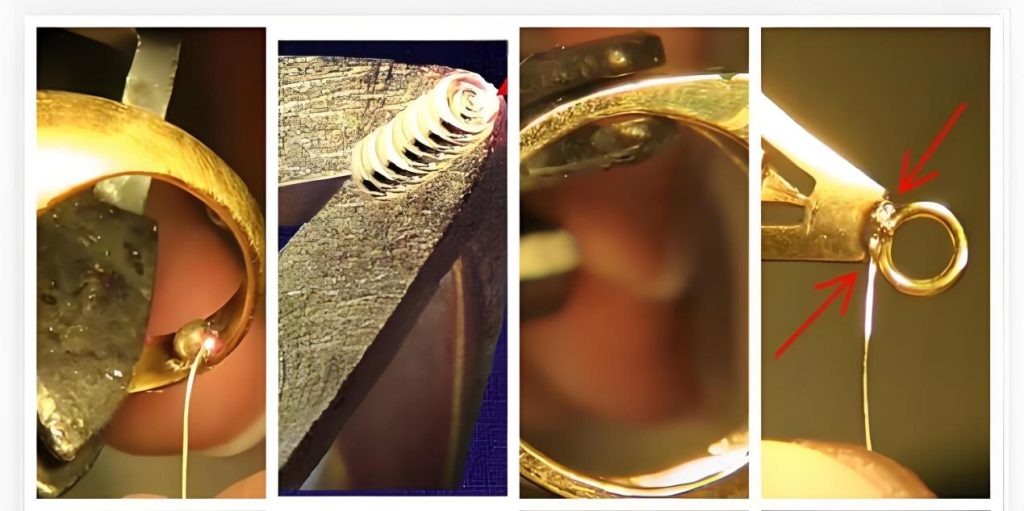
Ring Shank Repair: 0.4–0.8 mm
Ring shank repairs generally require a larger welding area than fine chains or prongs.
For many standard ring repairs, an initial spot size in the 0.4–0.8 mm range is worth evaluating, depending on the shank thickness, alloy, and joint design.
For a narrow sizing seam, a smaller spot may help concentrate energy at the joint.
For a wider section, the operator may need to adjust the spot size and pulse energy to achieve adequate fusion across the repair.
A useful distinction is between joining and finishing.
During the initial joint repair, the priority is sufficient penetration and a strong connection between the metal surfaces.
When adding filler wire or smoothing the repaired area, a somewhat larger spot may help distribute energy over a broader section.
For example, experienced jewelers may use a smaller spot to establish fusion and then increase the diameter for blending added metal.
However, widening the spot does not automatically improve joint strength. The underlying repair must already be properly fused.
A professional jewelry laser welding machine should allow the operator to adjust spot diameter and pulse characteristics independently for these different stages.
Fine Chains and Jump Rings: 0.2–0.3 mm
Fine chain repairs require particularly careful spot control.
Because chain links contain very little metal, excessive energy concentration can cause craters, melting, or complete burn-through.
For many fine chain and jump-ring repairs, 0.2–0.3 mm is a useful spot-size range to test when the equipment supports it.
The laser should be directed toward the joint that needs fusion rather than exposing the entire link to unnecessary heat.
Joint preparation matters just as much as spot size.
A poorly aligned chain link with a visible gap can be difficult to weld even with a very small laser spot.
Before welding, confirm that the ends are properly aligned and that the selected process is compatible with the material.
For a delicate gold or silver link, begin with the machine's appropriate low-energy preset and test the interaction between spot size, pulse duration, and energy.
If the link begins to melt excessively, do not assume that reducing the spot size will solve the problem. A smaller spot can increase energy concentration and make burn-through worse.
Gold-filled and plated chains require additional caution because laser welding can expose or mix the underlying base metal. Replacement may be more suitable for some constructions.
Prong Retipping: 0.2–0.4 mm
Prong repairs require a different approach from ring-shank welding.
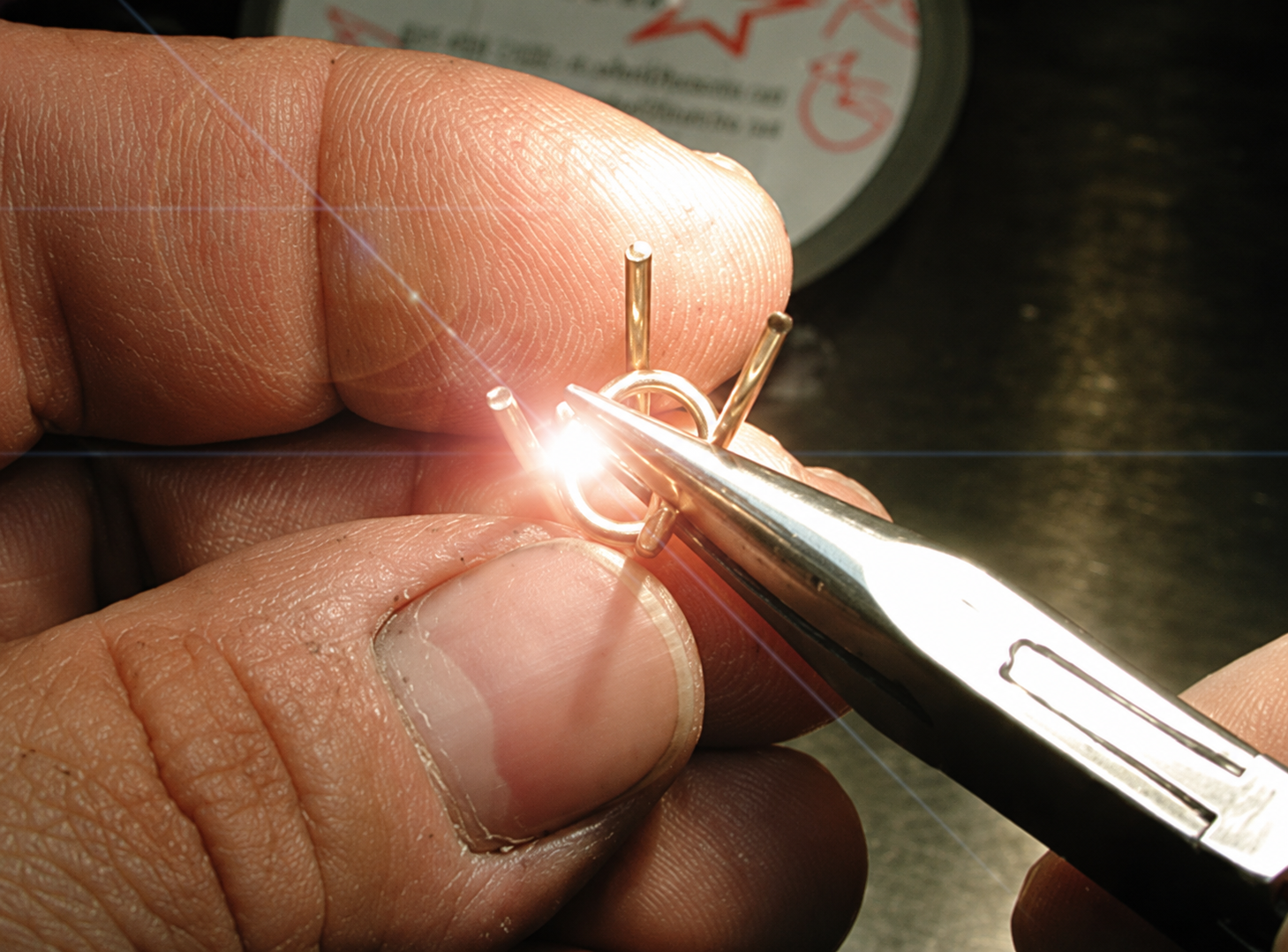
The purpose is often to attach a small amount of compatible metal or rebuild a worn tip without disturbing the surrounding setting.
For many fine prong repairs, a 0.2–0.4 mm spot is a useful starting range for testing.
A narrow spot allows the operator to work on a small attachment area.
However, the spot must still be large enough to produce proper fusion between the filler and original prong.
If the repair involves a weakened prong base rather than an intact but worn tip, a different repair approach or a slightly broader welding area may be required.
The distinction is important:
Retipping restores material to an otherwise sound prong. Rebuilding or replacing a cracked prong requires assessing the strength of the entire setting.
Laser welding is valuable for precision work around settings, but it does not make every gemstone safe from heat or laser exposure.
Heat-sensitive, treated, fractured, or otherwise vulnerable stones may require removal before repair. The jeweler must assess the stone and mounting individually.
For a laser welder for jewelry repair, accurate spot control is especially important when working on small prongs, bezels, and other detailed repairs.

2. How Does Spot Size Affect Penetration and Heat?
Spot size controls how laser energy is distributed across the metal.
At the same pulse energy and with other conditions unchanged, a smaller spot concentrates energy over a smaller area.
This can increase energy density and affect weld penetration.
A larger spot spreads energy across a wider area, which can change weld width, penetration, and heat distribution.
Smaller Spots Concentrate More Energy
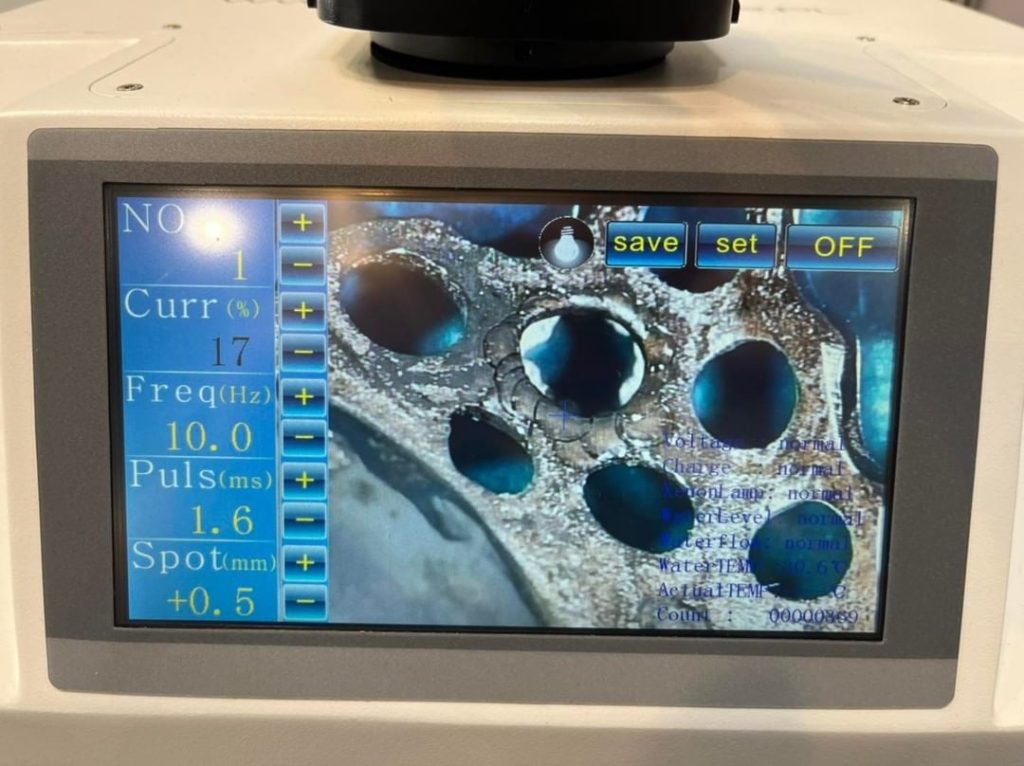
If the spot diameter is reduced by half while pulse energy remains the same, the average energy delivered per unit area increases approximately fourfold, assuming a comparable beam profile.
This is why a small spot can produce intense localized melting.
That concentration can be useful when working on narrow joints, but it can also cause pitting, spatter, or burn-through when the energy is too high for the amount of metal present.
A smaller spot does not automatically mean less heat damage.
For delicate jewelry, spot diameter and pulse energy must be adjusted together.
Larger Spots Spread Energy Across the Joint
Increasing spot diameter distributes the same pulse energy across a larger area.
This can be useful when smoothing filler metal or working over a wider repair section.
However, if the operator increases spot size without adjusting other parameters, the weld may become too shallow.
The visible bead can look broad and smooth while the underlying joint remains insufficiently fused.
Therefore, choose spot size according to the task.
Use a controlled, appropriately focused spot when creating the structural joint. Consider a broader spot when blending or smoothing material after adequate fusion has been established.
Spot Size Is Only One Parameter
Pulse energy, pulse width, focus, and pulse frequency also affect the result.
Pulse energy determines how much energy is delivered during a pulse.
Pulse width controls the duration of energy delivery.
Frequency affects how closely pulses follow each other and how much heat may accumulate during repeated welding.
Focus influences the actual beam size and intensity at the workpiece.
A nominal 0.3 mm spot setting cannot compensate for incorrect focus or poor joint preparation.
The best welding result comes from a balanced combination of spot diameter, energy, pulse duration, and correct positioning.

3. How Do You Find the Correct Spot Size?
The best way to choose a spot size is to start with the repair geometry and make controlled test welds.
Avoid copying a full set of laser parameters from another machine without confirming how that machine measures and delivers energy.
Test the Spot Size Before Repair
Use the following sequence:
Identify the metal and repair. Confirm the alloy, thickness, joint size, and whether the task is joining, filling, or smoothing.
Choose an initial spot diameter. Use the application ranges above as a guide, while following the machine manufacturer's recommendations.
Confirm the focus. Position the workpiece correctly under the microscope and ensure the laser pulse targets the intended joint.
Test on matching scrap. Begin with an appropriate conservative preset and observe how the metal responds.
Inspect and refine. Adjust one major variable at a time until the weld achieves adequate fusion without excessive melting.
Once the setting is proven, save the spot diameter together with the other laser parameters and repair details.
This is more repeatable than remembering one setting for all gold, silver, or platinum jewelry.
Adjust the Spot According to the Defect
When a test weld fails, examine the symptom before changing the spot size.
Welding Problem | Possible Cause | What to Check |
|---|---|---|
Burn-through or crater | Excessive energy concentration | Reduce energy; reassess spot size and focus |
Weak or shallow fusion | Insufficient delivered energy or poor fit-up | Confirm focus and joint; adjust energy or spot |
Excessive spatter | Unstable melting or contamination | Clean the joint; review pulse parameters |
Oversized weld area | Spot or energy too large for the task | Reduce excessive weld size and energy |
Uneven filler buildup | Poor positioning or unsuitable melting pattern | Check spot coverage and filler placement |
For example, if a thin chain link burns through, first investigate whether the delivered energy is excessive.
If a ring joint looks wide but lacks penetration, investigate focus and whether the energy is spread over too large an area.
If a prong repair forms a small crater, the solution may involve reducing pulse energy rather than making the spot even smaller.
Do not adjust spot size, pulse energy, and pulse width simultaneously.
Changing one parameter at a time makes it easier to understand why the weld improves.
Save Settings by Repair Type
A professional jewelry workshop may handle gold ring repairs, platinum prong rebuilding, and sterling silver chain repairs throughout the same day.
Instead of using one general-purpose welding program, save proven parameter combinations for frequently performed tasks.
Record the metal alloy, spot size, pulse energy, pulse width, and the actual repair result.
This reduces repeated trial-and-error and helps maintain consistent work across different operators.
4. What Spot Size Range Should a Jewelry Laser Welder Offer?
When purchasing a jewelry laser welder, the available spot-size range is an important specification.
However, the smallest advertised spot diameter should not be the only reason to choose a machine.
The equipment must deliver stable, controllable welding results across the types of repair the workshop performs.
Look for Adjustable Spot Diameter
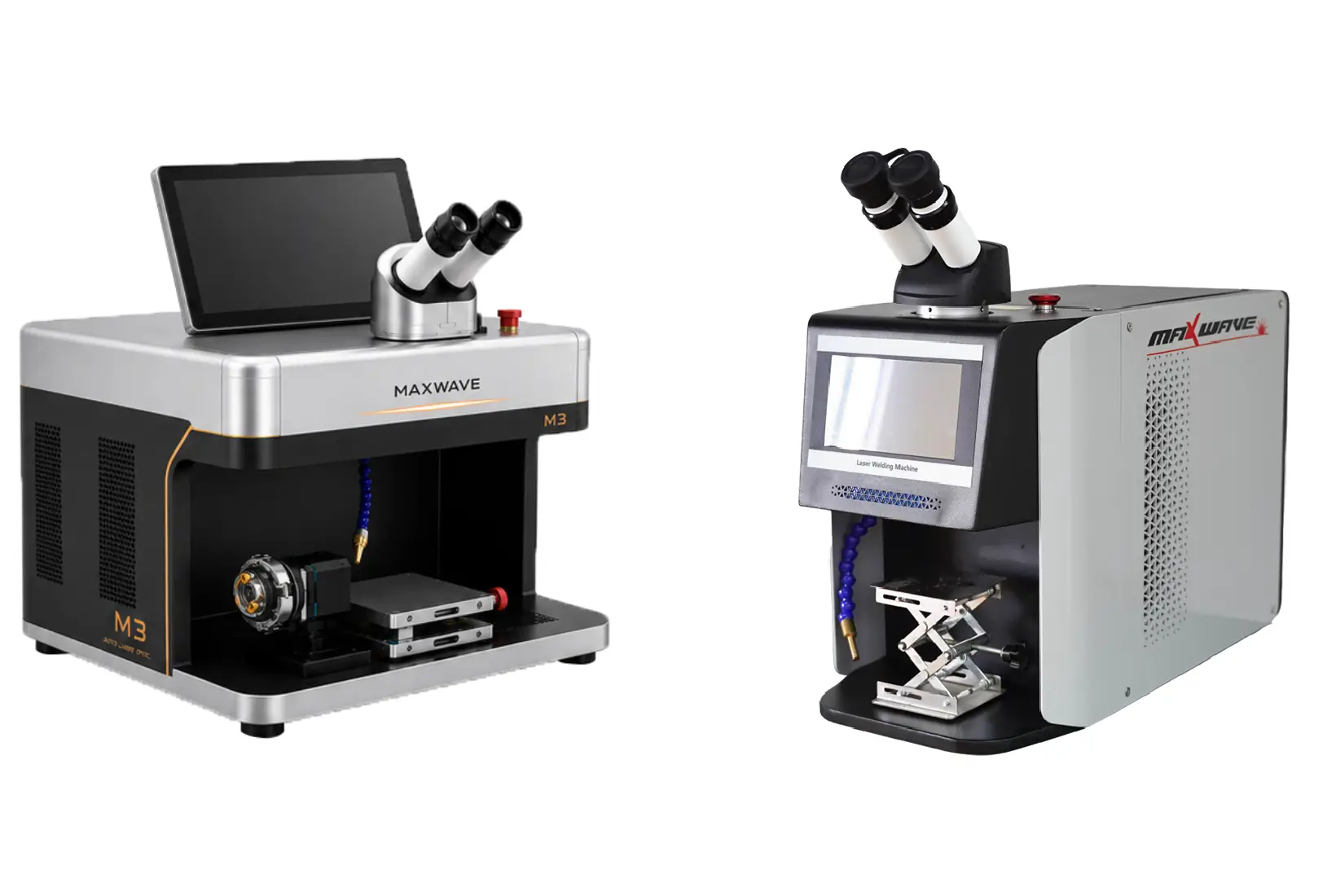
Many professional jewelry laser welders offer an adjustable spot diameter extending approximately from 0.1–0.2 mm at the narrow end to around 2.0 mm at the wide end, although the actual range varies by model.
Some machines provide a smaller minimum spot or a larger maximum spot.
For a workshop regularly repairing rings, chains, and prongs, the useful question is whether the machine can perform consistently at the spot sizes used in those tasks.
Fine chain and prong repair demand precise positioning and controlled energy delivery at small diameters.
Ring repair and filler blending benefit from the ability to use wider spots when appropriate.
A machine that offers both fine and broad spot adjustment gives the operator more flexibility across different jewelry repairs.
Check Pulse Control and Microscope Quality
Spot-size adjustment should work alongside suitable pulse-energy and pulse-width controls.
Good microscope visibility is also essential.
A jeweler must be able to position the workpiece accurately, align filler wire, and inspect the joint before firing.
For a laser welder for jewelry, practical usability matters as much as the specification sheet.
Other features worth evaluating include working-area accessibility, preset storage, compatible shielding gas arrangements, and support for the shop's normal repair workload.
Ask for Samples of Your Actual Repairs
Before buying, request sample welding demonstrations for the types of work your shop handles most often.
For example, ask the supplier to demonstrate a fine chain-link repair, a ring-shank joint, and a prong retipping task.
The demonstration should show not only the finished appearance but also the relevant welding configuration and, where appropriate, evidence of adequate fusion.
That provides a more useful comparison than a machine specification listing a minimum spot size alone.
Conclusion
What spot size is best for rings, chains, and prongs?
For many standard ring repairs, a 0.4–0.8 mm spot is a practical range to evaluate. Fine chains often require a smaller 0.2–0.3 mm spot, while prong repairs commonly benefit from controlled spot sizes around 0.2–0.4 mm.
Larger spots may also be useful for blending filler metal over wider ring repairs.
However, these ranges are starting references, not universal settings.
The correct spot diameter depends on the jewelry alloy, actual joint size, repair objective, and how the chosen machine delivers laser energy.
A small spot can improve precision but may increase the risk of burn-through if energy is not adjusted appropriately.
A larger spot can provide broader coverage but may reduce penetration if the delivered energy is insufficient.
Choose the spot that produces reliable fusion without unnecessary damage to the surrounding metal.
For jewelry repair shops, goldsmiths, and custom jewelry manufacturers, an adjustable jewelry welder makes it easier to move between delicate chain repairs, prong rebuilding, and heavier ring work.
Our team can help you evaluate suitable spot-size capabilities, machine configurations, and sample-welding results before selecting equipment.