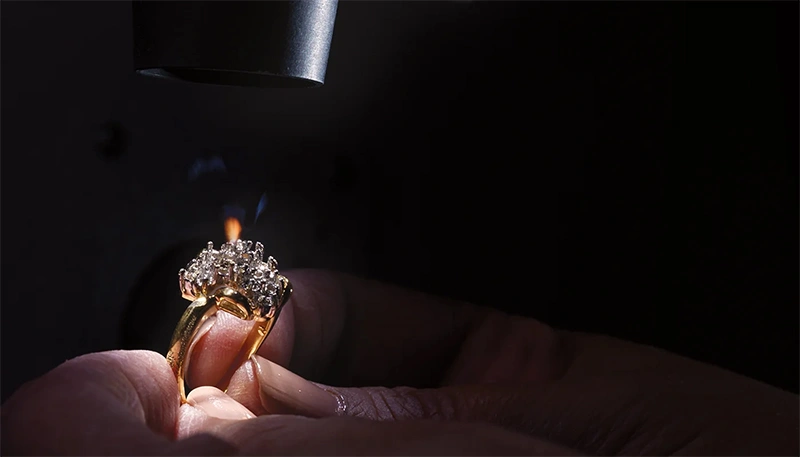
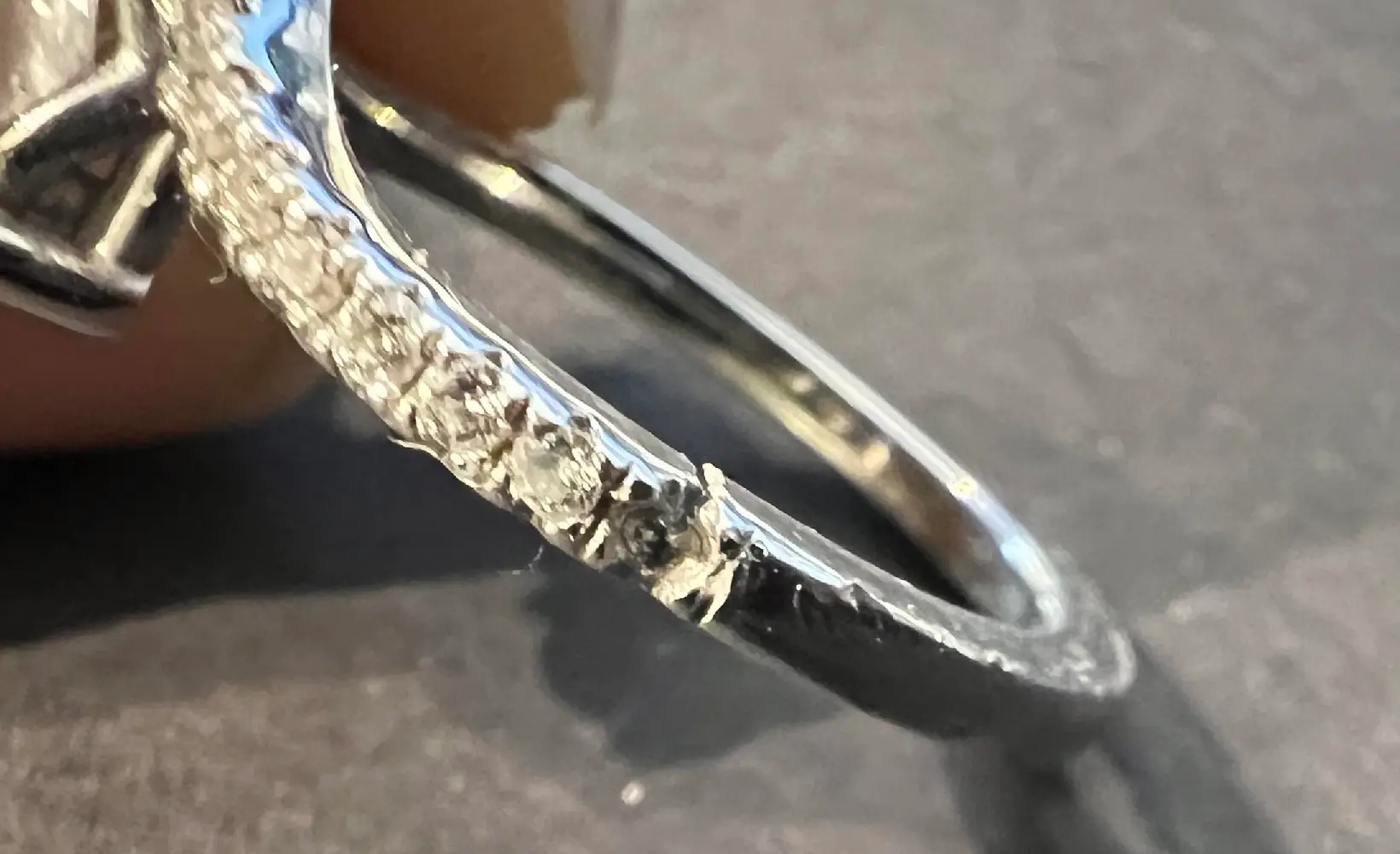
Yes, titanium jewelry can be laser welded, but not every titanium ring, chain, or damaged component is suitable for repair. Successful welding requires the correct titanium alloy, controlled laser energy, clean joint preparation, and effective inert-gas shielding.
Unlike gold and silver, titanium reacts strongly with oxygen and nitrogen at elevated temperatures. Without adequate protection, the welded area can become contaminated and brittle, even if the joint initially looks acceptable.
A professional jewelry laser welder can perform certain localized titanium repairs, but the machine must have suitable pulse control and a shielding arrangement proven to work with titanium.
For jewelers, the first step is deciding whether the repair is practical.
Titanium Jewelry Problem | Can Laser Welding Help? | Recommendation |
|---|---|---|
Small crack in a plain ring | Often possible | Assess the alloy and remaining metal |
Broken link or metal component | Possible for suitable joints | Test welding or consider replacement |
Titanium ring resizing | Difficult and design-dependent | Specialist assessment |
Stone-set or inlaid jewelry | Higher-risk repair | Assess construction before welding |
Surface scratches | Welding unnecessary | Refinish the surface |
The goal is to produce a sound repair without compromising the jewelry's strength, appearance, or original construction.
This guide explains which titanium repairs are realistic, what equipment and shielding they require, and when replacement or specialist repair is the better choice.
1. Which Titanium Jewelry Repairs Can Be Laser Welded?
Titanium is used in wedding bands, contemporary jewelry, small components, and some specialized settings.
It offers strength, relatively low weight, and good corrosion resistance. However, its properties also make conventional jewelry repair methods less straightforward.
Cracked Titanium Rings and Broken Components
A small, isolated crack in a plain titanium ring may be suitable for laser welding when the alloy is known and enough sound metal remains around the damaged area.
A pulsed laser can concentrate energy at the joint rather than heating the entire ring with a torch.
This allows a skilled operator to create localized fusion using appropriate titanium filler when needed.
The important question is whether the repair can restore the required strength.
A visible crack may extend farther than it first appears, especially if the ring has experienced significant deformation or repeated loading.
Before welding, inspect the affected area under magnification and determine whether the surrounding metal remains suitable for repair.
Broken titanium links or small attachments may also be repairable when they can be aligned, shielded, and welded without damaging neighboring components.
However, replacing a small connector may be easier and more economical than rebuilding it.
Titanium Ring Resizing and Stone-Set Jewelry
Can a titanium ring be resized using a laser welder?
Sometimes, but titanium resizing is much more limited than conventional gold or silver ring sizing.
Many titanium rings are manufactured from solid machined material. Their construction may make cutting, joining, or reshaping difficult.
Specialist manufacturers can sometimes increase the size of certain rings by carefully removing material from the inside.
Other designs may require rebuilding or replacing the ring.
Laser welding may be considered for selected joining operations, but it does not make every titanium band resizable.
Stone-set and inlaid titanium rings introduce additional risks.
Anodized finishes, decorative inserts, adhesives, and gemstones may be affected by heat or the preparation required for welding.
Tension-set jewelry needs particular care because modifying the metal can change the force holding the stone.
For extensive resizing, complex settings, or significant structural damage, replacement may be safer and more practical than welding.

2. What Does Titanium Laser Welding Require?
Titanium welding requires more attention to alloy identification, atmospheric protection, and surface preparation than many ordinary precious-metal repairs.
A suitable laser welder for jewelry must provide enough control to create the required fusion without unnecessarily heating the surrounding material.
Identify the Titanium Grade
Not all titanium jewelry uses the same material.
Common titanium grades include commercially pure titanium and titanium alloys containing additional elements.
Grade 1 and Grade 2 are commercially pure titanium grades that are generally weldable using suitable procedures.
Grade 5 (Ti-6Al-4V) is a stronger titanium alloy that can also be welded, but its properties and welding requirements differ from commercially pure titanium.
The correct filler material and welding parameters depend on the actual alloy.
Do not assume that a ring marked only as titanium is necessarily Grade 2.
If the grade is unknown, contact the manufacturer where possible.
For an expensive or structurally important piece, unknown material composition is a valid reason to decline or refer the repair.
Use High-Purity Argon Shielding
Titanium reacts with atmospheric gases when heated.
Oxygen and nitrogen contamination can reduce weld ductility and increase the risk of brittle failure.
High-purity argon is commonly used to protect titanium during welding. Helium or suitable inert-gas mixtures may also be used in qualified titanium welding procedures.
For jewelry-scale laser welding, argon is generally the more practical starting choice.
However, shielding needs to protect more than the visible laser spot.
The molten weld pool, adjacent heated metal, and cooling weld must remain adequately protected. The backside of a joint may also require shielding when sufficient heat reaches that surface.
For small titanium components, a properly designed inert-gas chamber may provide more consistent protection than an exposed welding arrangement.
A local shielding nozzle may be suitable for certain repairs, but its performance must be verified for the specific joint geometry.
There is no single gas-flow setting that works for every jewelry welder.
Gas purity, nozzle position, flow conditions, and protection during cooling all affect the result.
Argon shielding must remain effective while the metal is hot, not simply while the laser is firing.
Choose Suitable Pulse and Spot Controls
A pulsed Nd or suitably configured pulsed fiber laser may be used for precision titanium welding.
The most important controls include pulse energy, pulse width, spot diameter, and repetition frequency.
A small crack or fine component usually requires less weld volume than a thick ring-shank joint.
A narrow spot can concentrate energy on a small area, but excessive concentration may produce craters or unwanted melting.
A larger spot spreads energy across a wider area and may require adjustments to achieve sufficient penetration.
Pulse width also influences weld-pool behavior and heat distribution.
For titanium, the objective is to establish adequate fusion while maintaining atmospheric protection.
A fixed recommendation such as 150W or 200W is not enough to determine whether a machine can repair a particular titanium ring.
The actual pulse energy, joint geometry, shielding effectiveness, and verified welding result matter more than the machine's advertised wattage.
3. How Can Jewelers Avoid Failed Titanium Welds?
A successful titanium repair begins before the laser is activated.
Poor cleanliness, unsuitable filler, or incomplete argon protection can produce defects that are difficult to correct afterward.
Prepare and Test the Joint
A practical repair procedure should follow these steps:
Inspect the jewelry. Identify the titanium grade, joint thickness, damage, surface finish, and nearby stones or inlays.
Clean the metal. Remove oil, moisture, and contamination using methods suitable for titanium. Use clean, dedicated preparation tools.
Align the joint. Maintain suitable fit-up and secure the component without introducing additional contamination.
Verify shielding and test settings. Establish effective inert-gas coverage, then weld matching scrap before working on the customer's piece.
Weld and inspect. Use controlled pulses, maintain shielding during cooling, and examine the finished joint.
Avoid using ordinary carbon-steel wire brushes on titanium. Embedded iron particles can contaminate the welding area.
Any filler wire should also be clean and compatible with the identified titanium alloy.
If the test weld shows contamination or incomplete fusion, correct the cause before attempting the actual repair.
Common Titanium Welding Problems
Welding Problem | Possible Cause | What to Check First |
|---|---|---|
Gray or chalky weld | Severe oxidation or contamination | Shielding and atmosphere |
Pinholes or porosity | Moisture, contamination, trapped gas | Cleaning, filler, gas protection |
Cracking or brittle behavior | Contamination, material condition, unsuitable procedure | Alloy, joint, and weld integrity |
Weak or shallow fusion | Insufficient energy, poor focus, joint gap | Focus, pulse settings, fit-up |
Distortion or damaged finish | Excessive localized heating | Energy delivery and repair geometry |
Titanium weld discoloration deserves particular attention.
A bright silver appearance is generally a favorable sign of effective shielding, while gray, chalky, or heavily oxidized surfaces raise serious concerns.
However, weld color cannot independently confirm strength or freedom from internal contamination.
A clean-looking weld may still contain porosity or incomplete fusion.
Likewise, not every blue discoloration outside the fusion zone proves that the joint is defective.
If the weld has been significantly contaminated, polishing away the visible discoloration will not necessarily restore its mechanical properties.
For jewelry exposed to repeated loading, assess the repaired joint using an inspection method appropriate to the application.
Do not return a structurally uncertain titanium ring simply because the surface looks polished and clean.

4. Should Your Jewelry Shop Repair, Replace, or Outsource?
Laser welding can expand the repairs a jewelry workshop offers, but it does not mean every titanium job should be accepted.
A practical decision depends on the damaged piece, available equipment, operator experience, and the customer's expectations.
When In-House Repair Makes Sense
In-house titanium welding may be reasonable when the alloy is known, the damage is localized, and the shop has a suitable laser welding process.
The workshop should also have effective argon shielding, appropriate joint-preparation tools, and experience evaluating titanium weld quality.
For example, a small crack in an accessible plain band may be a more realistic repair than a fractured tension-set ring.
Likewise, a simple broken titanium component may be easier to evaluate than a heavily deformed piece with multiple previous repairs.
If titanium welding is only an occasional service, the cost of specialized equipment and training should also be considered.
A jewelry laser welding machine can support a range of precious-metal repairs, but titanium capability should be confirmed through representative sample testing.
When Replacement or Outsourcing Is Better
Consider replacement or specialist repair when the alloy is unknown, the ring is severely cracked or distorted, or the work would alter a complex setting.
Major resizing, damaged anodized finishes, decorative inlays, and thin or weakened structural sections may also make repair impractical.
Outsourcing is particularly useful when the shop does not have a qualified titanium shielding arrangement or cannot verify the finished joint.
Before referring the work, confirm that the specialist has experience with the relevant titanium alloy and jewelry construction.
A general metal welding service is not necessarily equipped to repair delicate titanium jewelry.
When explaining the decision to a customer, discuss the likely appearance, any potential changes to the original finish, and whether the repair can be warranted.
Avoid promising that the finished ring will have the same strength or appearance as an undamaged original without supporting evidence.
What Should You Look for in a Titanium Jewelry Welder?
If your workshop frequently receives titanium repair requests, choose equipment based on demonstrated performance rather than a minimum wattage claim.
A suitable laser welder for jewelry repair should offer adjustable pulse energy, pulse width, and spot diameter, along with accurate microscope viewing and appropriate shielding options.
Ask the supplier to demonstrate the machine on titanium samples with a known alloy and similar thickness to your expected repair work.
Evaluate the finished weld, surface appearance, penetration, and any relevant joint-quality requirements.
Also consider operator training, spare parts, warranty coverage, and technical support.
The correct machine should be capable of completing the shop's regular gold, silver, and platinum repairs while providing verified titanium capability for the applications it intends to accept.
Conclusion
Can you laser weld titanium jewelry?
Yes. Laser welding can repair certain titanium rings, broken components, and localized joints when the alloy, welding parameters, and inert-gas shielding are appropriate.
However, titanium requires more careful atmospheric protection than many conventional jewelry metals.
Commercially pure titanium and titanium alloys have different welding requirements, and a successful-looking weld does not automatically indicate adequate strength.
Some cracks and small component repairs may be practical. Major resizing, unknown alloys, heavily damaged bands, and complex stone-set designs may be better referred or replaced.
For professional jewelers, the best approach is to identify the material, evaluate the repair, verify shielding, and test the welding process before accepting the job.
A professional jewelry welder with adjustable pulse controls can support precision repairs, but titanium capability should be demonstrated on representative material.
Our team can help review the application, recommend a suitable machine configuration, and discuss whether a titanium sample-welding test is feasible before you purchase equipment.