Yes, titanium jewelry can be laser welded, but successful repairs require the right titanium alloy, controlled laser settings, and effective argon shielding.
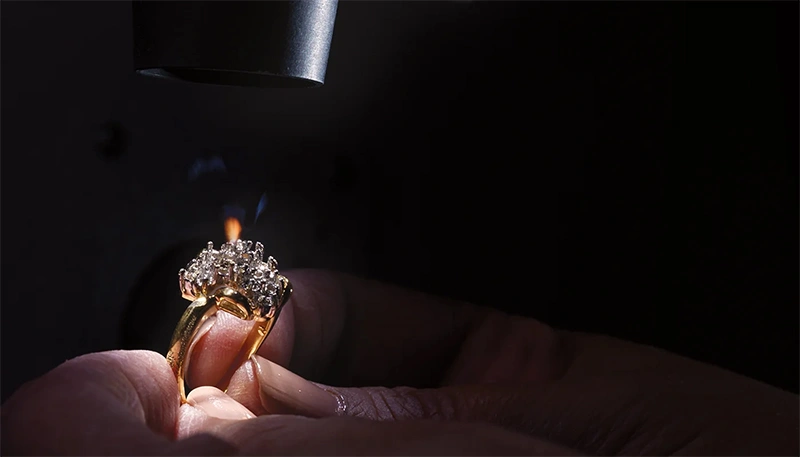
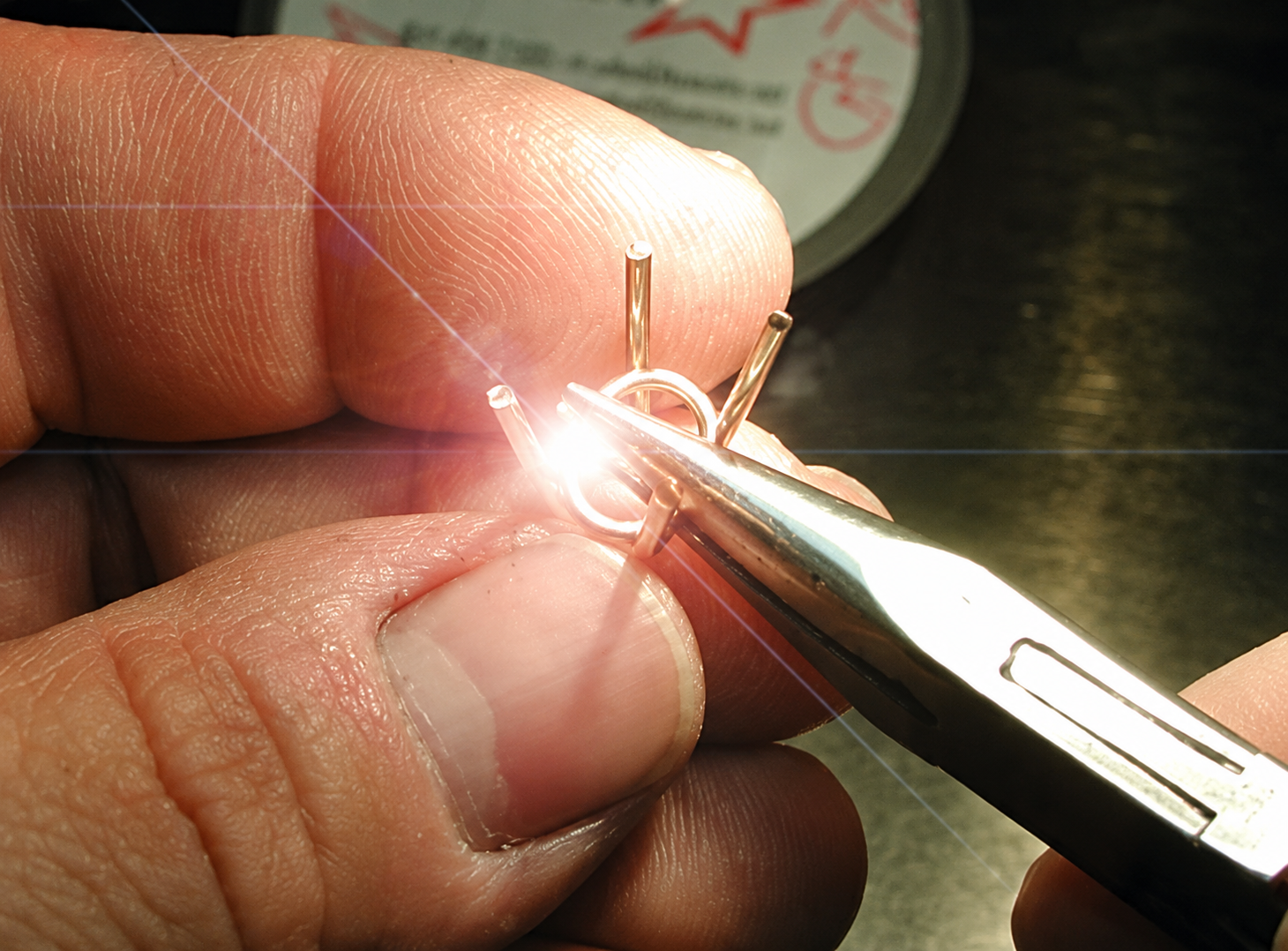
A pulsed jewelry laser welder can join or repair certain titanium rings, links, and small components by concentrating energy in a localized area. However, titanium behaves differently from gold, silver, and platinum because it reacts strongly with oxygen and nitrogen when heated.
Without adequate shielding, the weld can become contaminated, discolored, and brittle—even when it looks acceptable at first.
For jewelers, the most important question is not simply whether titanium can be welded. It is whether a particular piece can be repaired safely, cleanly, and economically.
Titanium Jewelry Repair | Is Laser Welding Practical? |
|---|---|
Small crack in a plain titanium band | Often possible with suitable equipment and shielding |
Broken titanium link or component | Possible when the alloy and joint are suitable |
Titanium ring resizing | Difficult; specialist assessment required |
Stone-set, inlaid, or coated titanium jewelry | Higher risk; replacement may be preferable |
The best approach is to identify the titanium grade, prepare the joint, establish complete shielding, and develop suitable parameters on matching scrap before working on the customer's jewelry.
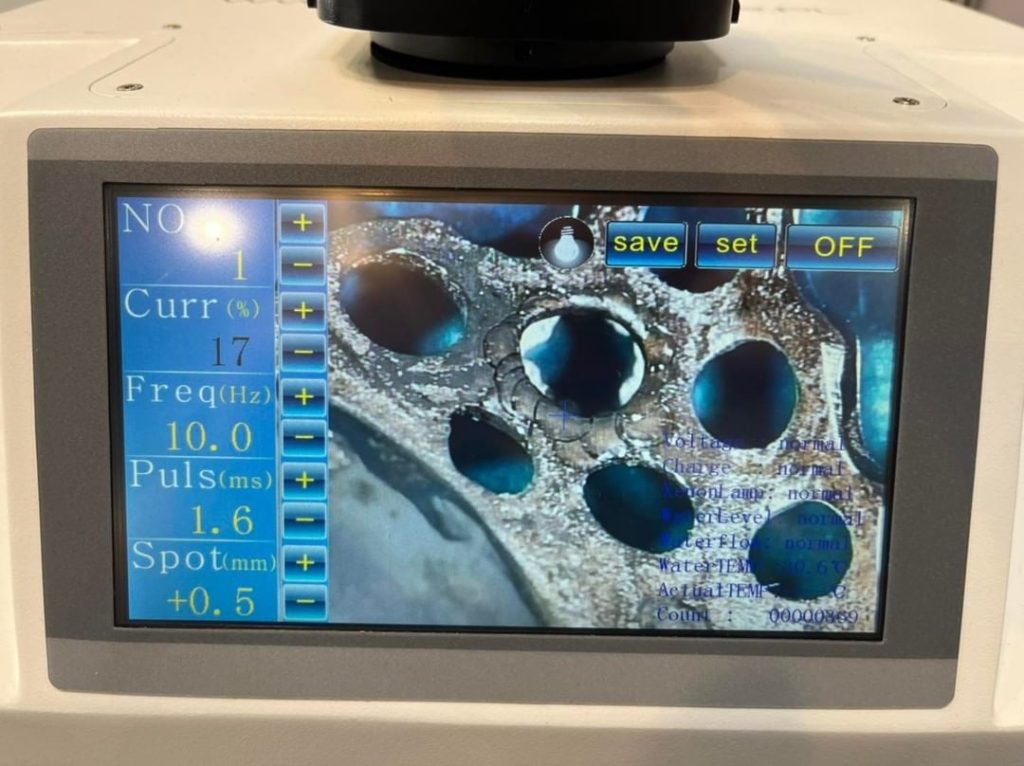
A professional jewelry laser welder provides adjustable pulse energy, pulse width, and spot size for localized welding, but titanium compatibility should be demonstrated on the actual machine rather than assumed from its power rating alone.
1. How Should You Set a Jewelry Laser Welder for Titanium?
Titanium laser welding settings depend on the alloy, joint thickness, and the type of repair.
Unlike ordinary gold repairs, titanium requires particularly careful control of both laser energy and atmospheric contamination.
Identify the Titanium Grade
Before setting the machine, confirm whether the piece is commercially pure titanium or a titanium alloy.
Grade 1 and Grade 2: Commercially pure titanium grades are generally weldable and may be suitable for certain small jewelry repairs when adequate shielding is available.
Grade 5 (Ti-6Al-4V): A stronger titanium alloy used in various engineered products and some jewelry. It can be laser welded, but its welding procedure, filler compatibility, and final properties need appropriate verification.
If the grade is unknown, ask the jewelry manufacturer for the material specification. A ring marked only “titanium” does not necessarily identify its exact alloy.
Do not assume that the same settings will work for Grade 2 and Grade 5.
Adjust Pulse Energy, Width, and Spot Size
A pulsed laser welder for jewelry allows the operator to control energy delivery in small, localized welds.
The most important settings are:
Parameter | Starting Approach | Main Risk |
|---|---|---|
Pulse Energy | Start within the manufacturer's recommended range and increase gradually | Cratering or insufficient fusion |
Pulse Width | Use controlled pulses suited to joint thickness | Excessive heat or shallow penetration |
Spot Size | Match the spot to the actual repair area | Burn-through or insufficient fusion |
Frequency | Use a controlled welding pace | Heat accumulation |
For a thin titanium link or small crack, begin with conservative settings and a spot size suited to the joint.
For a thicker ring section, greater penetration may be required, but do not simply increase every parameter.
The goal is to achieve sufficient fusion without repeatedly overheating the surrounding material.
Test Before Welding the Jewelry
Do not start with the customer's ring.
Use a representative titanium sample with the same known alloy and similar thickness whenever possible.
Prepare the sample, establish the required argon shielding, and make a controlled test weld.
Inspect the result for fusion, porosity, cracking, and discoloration.
If the weld is too shallow, check focus and joint fit-up before gradually adjusting energy delivery. If the weld develops craters or excessive melting, reduce the energy concentration and inspect the setup.
Change one major parameter at a time.
Do not copy settings from an industrial 850W continuous-wave titanium welding process into a small pulsed jewelry machine. The laser source, beam characteristics, and welding conditions are fundamentally different.

2. Why Is Argon Shielding Essential for Titanium?
Argon shielding is one of the most important differences between welding titanium and repairing conventional precious metals.
Titanium reacts readily with oxygen, nitrogen, and hydrogen at elevated temperatures. Atmospheric contamination can increase hardness while reducing ductility, potentially leaving the weld brittle.
The Welding Institute (TWI) identifies atmospheric protection and cleanliness as central requirements for welding titanium and its alloys.
Protect More Than the Weld Pool
A common mistake is assuming that argon only needs to cover the spot where the laser hits the metal.
In practice, protection may be required in three areas:
Primary Shielding: Protects the molten weld pool during each laser pulse.
Cooling Weld Area: Protects the hot weld and surrounding heat-affected zone as the metal cools.
Backside Protection: Prevents atmospheric contamination on the reverse side of the joint when heat reaches that surface.
For small titanium jewelry repairs, the exact arrangement depends on the piece and the welding enclosure.
An integrated argon nozzle may provide suitable coverage for some localized repairs, but other geometries may require additional shielding or a controlled inert-gas chamber.
The critical point is that titanium must remain adequately protected while the weld is hot, not only while the laser is firing.
Use Clean, High-Purity Argon
High-purity argon is commonly used for titanium welding.
However, there is no single flow rate that works for every jewelry laser welding machine.
The appropriate flow depends on the nozzle, distance, joint geometry, and whether additional protection is required.
Too little flow can allow atmospheric contamination.
Excessive or turbulent flow can also reduce shielding effectiveness.
Follow the gas-system and welding-procedure recommendations supplied with the machine, and verify shielding effectiveness on a representative sample.
For high-value or difficult titanium repairs, a properly designed inert-gas chamber may offer more consistent atmospheric protection than an exposed bench arrangement.
What Does Titanium Weld Color Tell You?
Titanium weld color can provide a useful warning about atmospheric exposure.
Weld Appearance | What It May Indicate |
|---|---|
Bright silver | Often associated with effective shielding |
Light straw | Minor surface oxidation |
Dark blue or purple | Possible shielding or oxidation concern |
Gray | More serious contamination concern |
White or chalky | Severe surface oxidation |
However, weld color is not a complete quality test.
A silver-looking weld can still contain internal defects or contamination, while certain colors outside the weld bead may not indicate a defective joint.
TWI specifically warns against relying on color alone to determine titanium weld integrity.
For a jewelry laser welding machine, correct gas coverage should be validated alongside weld appearance, fusion, and the repair's required mechanical performance.
If shielding is clearly inadequate, stop welding rather than continuing to add pulses.

3. Which Titanium Jewelry Repairs Are Practical?
Laser welding can make some titanium jewelry repairs possible, but not every damaged titanium piece should be repaired.
The best candidates generally have accessible joints, identifiable material, and enough sound metal remaining to support the repair.
Repairing Cracks in Titanium Rings
An isolated crack in a plain titanium band may be repairable using a suitable laser welding process.
First, inspect the surrounding metal under magnification.
Determine whether the crack is localized or part of a larger structural failure.
If the surrounding material is sound, the repair may involve removing damaged or contaminated metal, aligning the joint, and rebuilding it through controlled welding under argon.
Compatible titanium filler may be required when the repair involves missing material or a gap.
However, a crack caused by significant deformation or repeated failure deserves more caution than an isolated manufacturing defect.
Do not simply melt over the visible crack and assume the ring is restored.
Can You Resize a Titanium Ring?
Titanium ring resizing is much more difficult than resizing gold or platinum.
Conventional jewelry soldering methods generally do not transfer directly to titanium.
A specialist may be able to modify certain plain titanium bands through appropriate machining or joining methods, but this depends on the alloy, construction, wall thickness, and finish.
For many commercially manufactured titanium rings, replacement is more practical than resizing.
This is particularly important for coated, anodized, inlaid, or tension-set designs.
A manufacturer specializing in titanium rings may be better equipped to determine whether a specific design can be modified without compromising its appearance or function.
Repairing Links, Clasps, and Small Components
Some broken titanium links or small components may be suitable for localized laser welding.
These repairs are more practical when the pieces can be properly cleaned, aligned, and shielded.
For very small components, the operator must balance sufficient fusion against the risk of overheating or changing the component's geometry.
If a clasp mechanism or small joint has already lost significant material, replacing the component may be safer and more economical than rebuilding it.
Repairs Near Stones or Inlays
A laser welder for jewelry repair allows localized heat delivery, which can be useful near delicate features.
However, this does not mean every stone-set titanium piece can be welded without removing the stone.
Gemstones, adhesives, surface coatings, and decorative inlays may be damaged by nearby heat or by the changes required to prepare and finish the joint.
Tension-set jewelry presents an additional concern because modifying the metal can change the pressure holding the stone.
Before attempting these repairs, determine whether the original construction can be safely preserved.
A technically possible weld is not automatically a suitable jewelry repair.

4. How Do You Prevent Common Titanium Welding Problems?
Most unsuccessful titanium welds should be investigated through three areas: material condition, surface cleanliness, and shielding effectiveness.
Laser parameters matter, but simply increasing energy will not correct contamination or a structurally compromised joint.
Problem | Possible Cause | What to Check |
|---|---|---|
Excessive discoloration | Inadequate shielding or atmospheric exposure | Gas coverage and cooling protection |
Porosity | Moisture, contamination, or trapped gas | Joint cleanliness and filler condition |
Weak fusion | Incorrect focus, joint fit, or energy delivery | Focus, alignment, and test settings |
Cracking | Contamination, embrittlement, or existing damage | Material condition and shielding |
Burn-through | Excessive localized energy on thin metal | Spot size, energy, and pulse duration |
Do Not Hide Contamination With Polishing
A dark or heavily oxidized titanium weld should not simply be polished until it looks acceptable.
Surface finishing can improve appearance, but it does not necessarily correct contamination or defects within the welded region.
If the joint's integrity is uncertain, inspect and qualify the repair before returning the jewelry to the customer.
For a structurally important joint, visual inspection alone may be insufficient.
Know When to Stop the Repair
Sometimes the most professional decision is not to continue welding.
A severely fractured band, unknown alloy, damaged tension setting, or repeatedly failed joint may be better replaced or referred to a specialist.
Reworking the same titanium area without correcting the original problem can introduce additional heat and contamination.
Repair quality matters more than completing every job with the laser.
Conclusion
Can you laser weld titanium jewelry?
Yes, but titanium requires more careful material identification and atmospheric protection than many conventional jewelry metals.
Pulsed laser welding can be suitable for certain cracks, broken links, and localized repairs. However, complex ring resizing, coated jewelry, inlaid pieces, and stone settings may be difficult or unsuitable for welding.
For the best results, focus on three priorities:
Match the settings to the titanium grade and repair.
Maintain effective argon shielding throughout the hot welding and cooling stages.
Inspect the joint before accepting the repair.
Do not rely on one universal titanium setting, and do not assume that a silver-looking weld automatically has adequate strength.
Before purchasing a jewelry welder specifically for titanium repairs, confirm that the machine and shielding arrangement have been demonstrated successfully on representative titanium samples.
If you are considering titanium jewelry repair, send JewelryLaserNova photographs of the piece, its titanium grade if known, the repair area, and the type of damage. Learn more about JewelryLaserNova's factory-direct laser welders before reaching out.
Our team can help review the application, discuss suitable machine configurations, and determine whether a titanium sample-welding test is feasible before you select equipment.