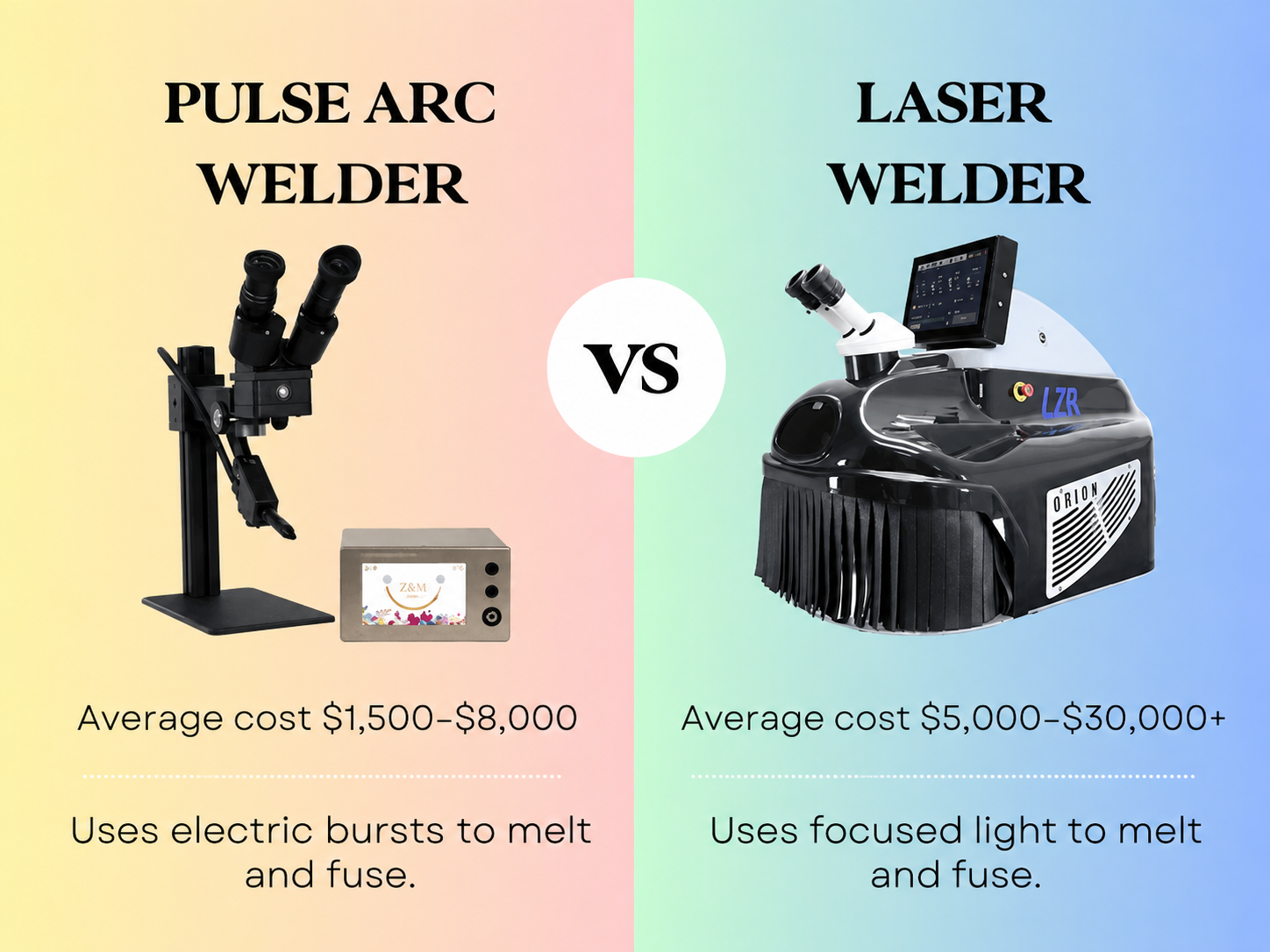
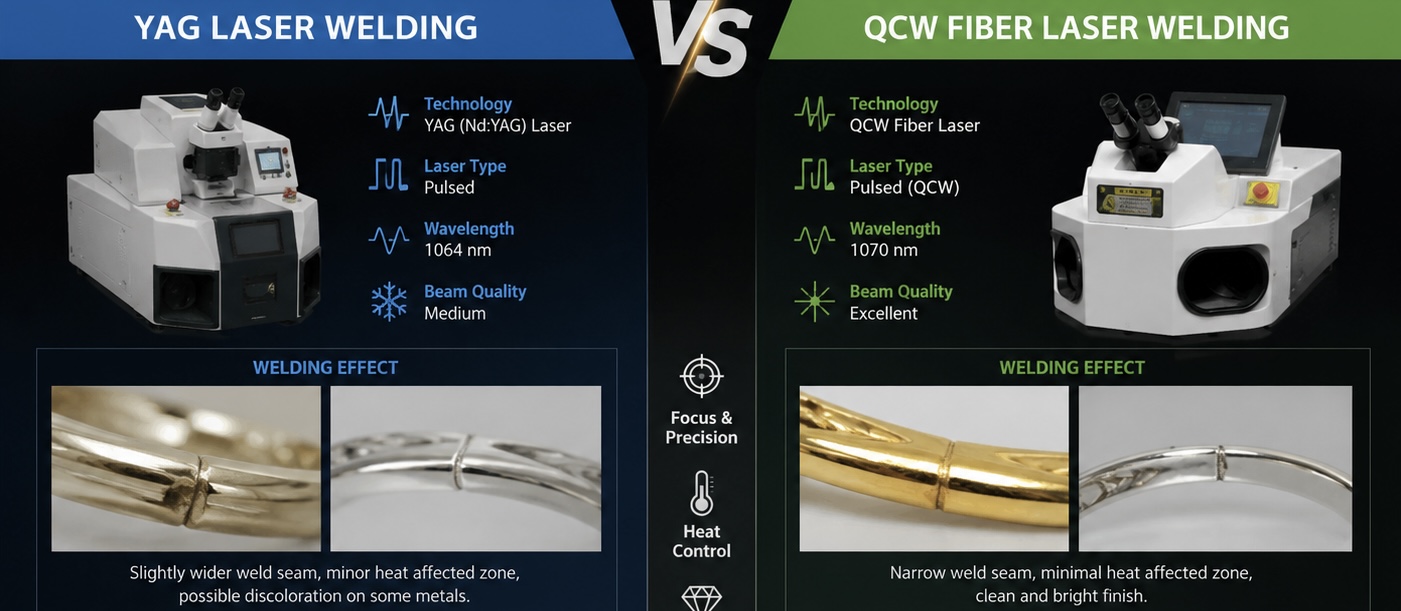
Laser welding and soldering are both valuable jewelry-repair methods, but they solve different problems.
For most jewelers, the choice is not about deciding which technology is universally “better.” It is about choosing the process that gives the safest, cleanest and most practical repair for the piece in front of you.
In general:
Use laser welding when you need highly localized heat, precise metal buildup or repairs close to heat-sensitive areas.
Use soldering when you need solder to flow through a larger joint, the piece can safely tolerate broader heating, or a traditional soldered assembly is simply faster and more economical.
A jewelry laser welder becomes particularly valuable for repair shops handling stone-set rings, worn prongs, fine chains, platinum, porosity and other repairs where controlling heat around the rest of the piece matters.
But soldering is not obsolete. A professional bench often benefits from having both.
1. What Is the Real Difference Between Laser Welding and Soldering?
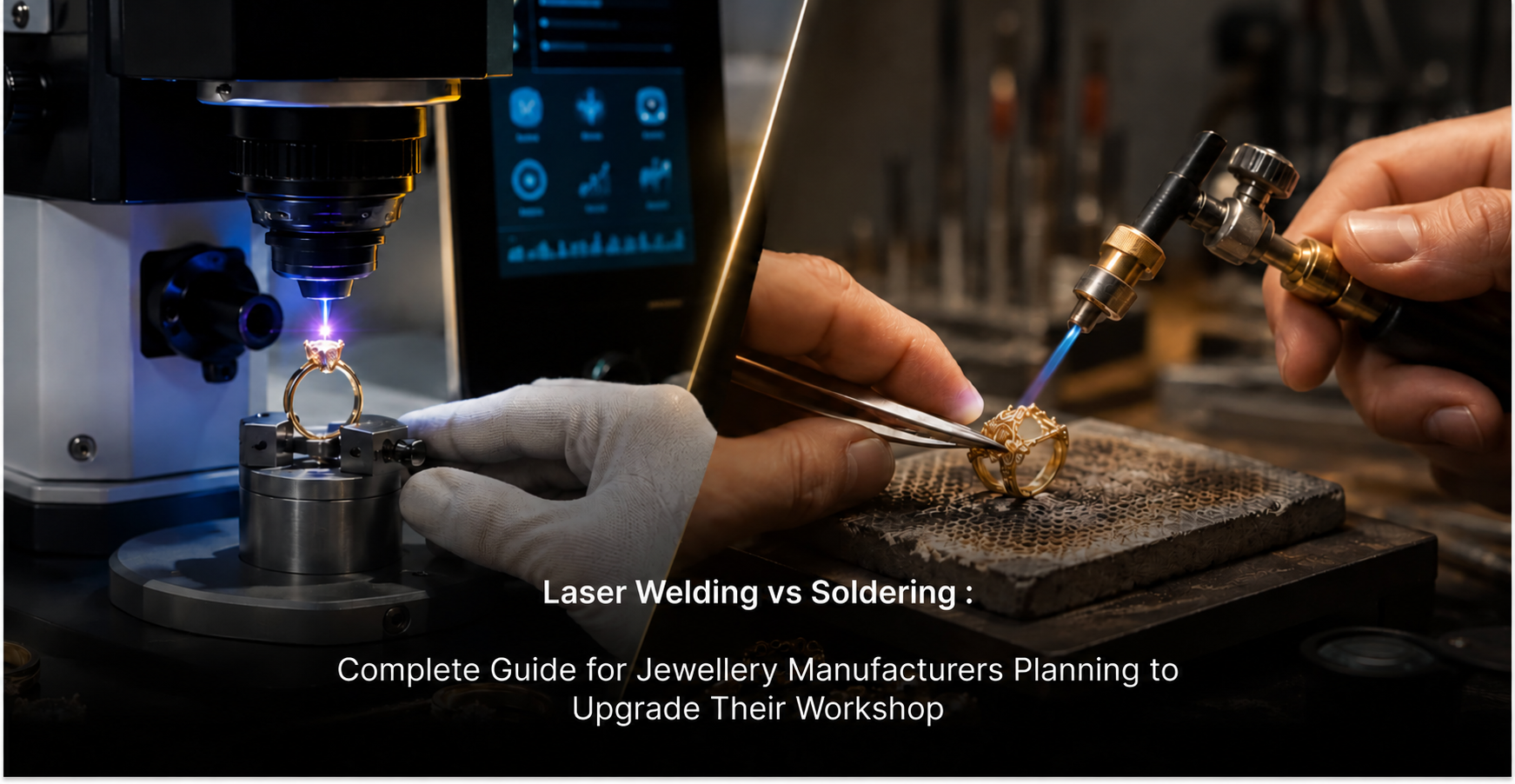
The biggest practical difference is how the joint is created and how much of the jewelry is heated.
Laser Welding
Jewelry laser welding uses a concentrated pulse of laser energy to melt a very small area of the base metal. Filler wire can also be added when the repair needs additional material.
Because the energy is concentrated at the weld point, relatively little of the surrounding piece needs to be heated.
That makes laser welding for jewelry repair especially useful when the repair is close to gemstones, delicate settings, thin sections or areas that would be difficult to heat safely with a torch.
Soldering
Soldering joins jewelry using a filler alloy with a lower melting temperature than the base metal.
The torch heats the surrounding area until the solder flows through the joint.
This works extremely well for many traditional jewelry tasks, but heat spreads through a larger section of the piece.
That wider heat zone is often completely acceptable on a plain gold ring or a fabrication joint. It becomes more difficult when fragile gemstones, previous solder joints, enamel, plating or very thin components sit nearby.
Quick Comparison
Factor | Laser Welding | Soldering |
|---|---|---|
Heat affected area | Very localized | Wider |
Works close to stones | Major advantage | Often requires more protection or stone removal |
Adding metal to a worn area | Excellent | Possible, but different workflow |
Large solder-flow joint | Not always the most efficient | Excellent |
Fine chain / prong work | Strong advantage | More heat-management difficulty |
Traditional fabrication | Useful | Often very practical |
Equipment cost | Higher | Much lower |
Learning requirement | Machine + welding technique | Torch + soldering technique |
Post-repair cleanup | Often limited | Flux, oxidation and solder cleanup may be required |
Best workshop setup | Precision repair | General fabrication and traditional repair |
The important point is that joint quality depends on technique, fit-up, filler choice and repair design as much as the process itself.
A poorly executed laser weld can fail. A properly designed solder joint can last for decades.
2. When Should You Use Laser Welding for Jewelry Repair?
Laser welding makes the strongest case when broad heating creates unnecessary risk or when you need to add metal very precisely.
Prong Retipping and Setting Repair
Worn prongs are one of the clearest applications.
Instead of heating the entire setting, a laser welder for jewelry allows the jeweler to add small amounts of matching metal directly to the worn area.
This is useful for rebuilding prong tips, repairing localized setting damage and restoring metal around a stone.
The advantage is not just speed. It is control.
You are putting energy where the repair is needed instead of heating the complete head.
Repairs Near Gemstones
Stone-set jewelry is another major reason shops invest in laser equipment.
Diamonds, sapphires and rubies may often remain in place during appropriate laser repairs, while heat-sensitive or treated stones still require more caution.
The original draft correctly identifies gemstone protection as one of the most important differences between laser welding and broader torch heating.
Laser welding does not mean every gemstone can remain installed.
The stone type, treatments, inclusions, repair location and required welding energy still determine whether removal is safer.
But when the application allows it, reducing the need to remove and reset stones can significantly simplify a repair.
Fine Chains and Delicate Components
Fine chains can be difficult to solder because nearby links heat quickly.
The same issue appears with:
Thin bracelet components.
Fine filigree.
Small clasps.
Earring posts.
Delicate decorative structures.
A laser can concentrate the repair on one small area without applying the same amount of heat to neighboring sections.
For a shop that performs high volumes of chain and clasp repairs, this alone can make a jewelry laser welding machine useful.
Hollow Jewelry
Hollow pieces deserve careful heat control because the metal wall may be very thin.
Laser welding can be highly useful here because the operator can control the weld area precisely.
But I would not keep the original article's claim that laser welding is “the only safe move.”
Experienced jewelers may still use soldering successfully on certain hollow constructions.
The better rule is:
The thinner and more heat-sensitive the construction, the stronger the case for laser welding.
Porosity, Cracks and Local Metal Buildup
Laser welding is also useful when the repair is not really a traditional “join.”
For example:
Filling casting porosity.
Repairing a localized crack.
Building up a worn prong.
Adding material to a damaged edge.
Filling a small surface defect before polishing.
These jobs benefit from the ability to deposit very small amounts of metal exactly where needed.
Platinum and High-Value Repair
Laser welding is especially attractive for platinum repair and other high-value work where localized control matters.
Platinum ring sizing, prong repair and setting work can all benefit from precise energy placement.
This does not mean soldering cannot be used on platinum.
It means a professional jewelry welder gives the repair shop another method when broad heating would make the job more difficult.

3. When Is Soldering Still the Better Choice?
A jewelry laser welder should expand your bench capability—not make you abandon soldering.
There are many situations where soldering remains faster, simpler or more economical.
Large, Well-Fitted Traditional Joins
If you are joining two substantial pieces and want solder to flow through the complete joint, soldering may be the more natural process.
This is common in general jewelry fabrication.
The solder can flow through a larger contact area in one heating operation, while trying to build the same complete seam with many individual laser welds may take longer.
Plain Ring Sizing
For a simple gold ring with no heat-sensitive stones close to the sizing area, traditional soldering can still be extremely efficient.
Cut the shank, adjust or insert metal, solder the joint, reshape and finish.
There is no reason to force every simple ring sizing job onto the laser just because the machine is available.
Laser welding becomes more valuable when:
The setting is close to the sizing area.
The ring contains heat-sensitive features.
Previous solder joints may be affected.
The shank is unusually thin.
Precise localized repair is needed.
So the right question for ring sizing is not:
Laser or solder?
It is:
Does this particular ring benefit from localized heat?
Fabrication Work Where Solder Flow Is Useful
Traditional jewelry fabrication is built around soldering for a reason.
When assembling larger sections, bezels, decorative elements or multiple joints, solder's ability to flow through a fitted seam can be extremely useful.
A laser pulse creates localized fusion. It does not automatically replace every operation where capillary solder flow is part of the construction method.
When Equipment Cost Does Not Make Sense
Soldering also wins on entry cost.
A torch bench costs far less than a professional laser system.
For a jeweler performing relatively few repairs and rarely working near stones, a laser may not provide enough additional value to justify the capital investment.
The buying case becomes stronger when the shop regularly handles jobs that are slow, risky or impossible with the current soldering workflow.
When the Operator Already Has an Efficient Soldering Process
Do not replace a process simply because another technology exists.
If a skilled goldsmith can solder a particular repair quickly, safely and consistently, moving that job to the laser may not create a meaningful benefit.
The laser should solve an actual bench problem.

4. Which Method Should You Use for Common Jewelry Repairs?
For most repair shops, a repair-by-repair comparison is more useful than theoretical strength numbers.
Repair | Better Starting Method | Why |
|---|---|---|
Prong retipping near a stone | Laser welding | Precise metal buildup and localized heat |
Broken fine chain | Laser welding | Less heat transferred to nearby links |
Simple plain ring sizing | Soldering or laser | Both can work; choose by workflow |
Ring sizing close to stones | Laser welding | Lower heat exposure around the setting |
Casting porosity | Laser welding | Localized filling |
Small crack in a ring or setting | Laser welding | Precise fusion in a small area |
Large fabrication seam | Soldering | Solder flow can join a larger area efficiently |
Hollow or very thin jewelry | Often laser welding | Better localized heat control |
Platinum prong repair | Laser welding | Precise buildup and limited surrounding heat |
General fabrication | Often soldering | Lower cost and efficient for many conventional joins |
What About Joint Strength?
I would remove the original claims that laser welds are “2600% stronger” or universally stronger than solder.
Those numbers are too broad to apply across every gold alloy, joint geometry, filler metal and repair technique. The original draft makes very strong universal strength claims that are not necessary to answer the user's real question.
A better way to explain it is:
Laser welding can create direct fusion between the base metals, while soldering relies on a lower-melting filler alloy.
That difference can be important in high-stress localized repairs.
But whether the finished joint is strong enough still depends on:
Joint geometry.
Base alloy.
Penetration.
Filler material.
Fit-up.
Porosity.
Operator technique.
Finishing.
For a professional repair shop, the correct target is not “laser is stronger.”
It is:
Choose the process that produces a reliable repair for the actual load and construction of the piece.
What About Repair Speed?
Laser welding can save significant time on certain repairs because it may reduce stone removal, broad heat protection, flux cleanup and oxidation cleanup.
This is particularly noticeable with stone-set jewelry and localized repairs.
But laser is not automatically faster on every job.
If a jeweler needs to join a large, simple seam and solder can flow through it in one operation, soldering may be faster than building the seam pulse by pulse.
That is why the strongest repair benches use both methods rather than turning the comparison into a winner-takes-all decision.
Do You Need Both?
For a professional jewelry repair shop, often yes.
Soldering remains an essential bench skill.
Laser welding adds another level of capability for jobs where precision, heat control and localized metal buildup matter.
A good workflow might look like this:
Simple fabrication and low-risk joins → soldering
Stone-set repairs, prongs, thin chains and localized defects → laser welding
Complex repair → use whichever process—or combination of processes—gives the safest result
That is a much more useful way to think about the investment.
Conclusion
Laser welding and soldering are not competing tools where one must completely replace the other.
They are best at different types of jewelry work.
Use laser welding when you need highly localized heat, precise filler-metal placement or repair close to gemstones and delicate structures.
Use soldering when broad heating is acceptable and you need efficient solder flow through a traditional fitted joint.
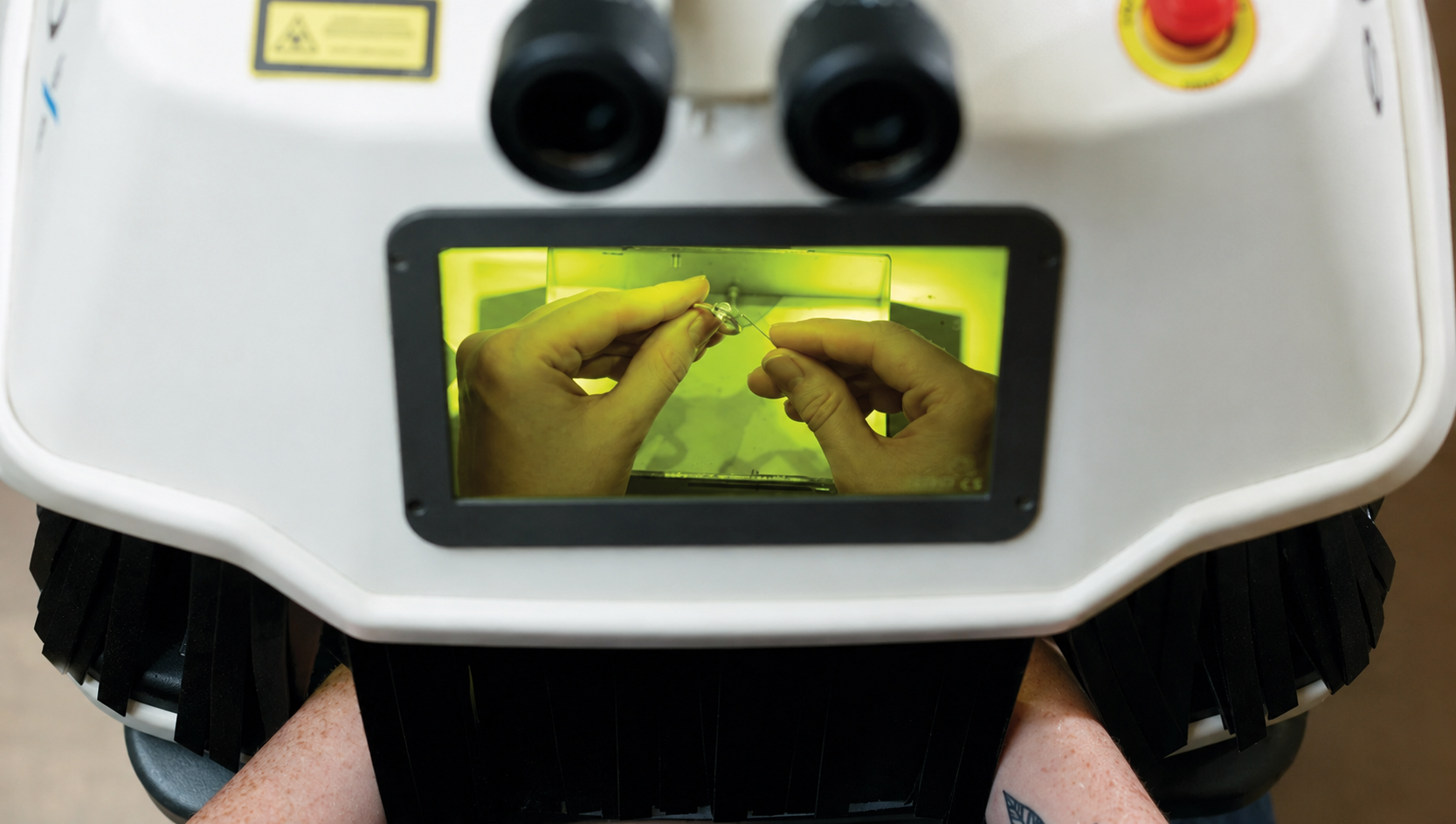
For a repair-focused business, jewelry laser welding becomes most valuable when your current torch workflow forces you to remove stones, protect large areas from heat, spend extra time cleaning oxidation or turn away delicate repairs altogether.
That is the point where the machine starts solving real business problems rather than simply adding another tool to the bench.
The simplest decision rule is:
Stone-set, thin, delicate or highly localized repair → consider laser first.
Large, conventional and heat-tolerant joint → soldering may still be simpler.
Unsure → evaluate the piece, not the technology label.
If you are considering adding laser welding to your workshop, send JewelryLaserNova examples of the repairs you currently solder—such as rings, prongs, chains, platinum pieces or stone-set jewelry. The team can perform sample welding and help you determine which jobs would actually benefit from bringing laser welding in-house.