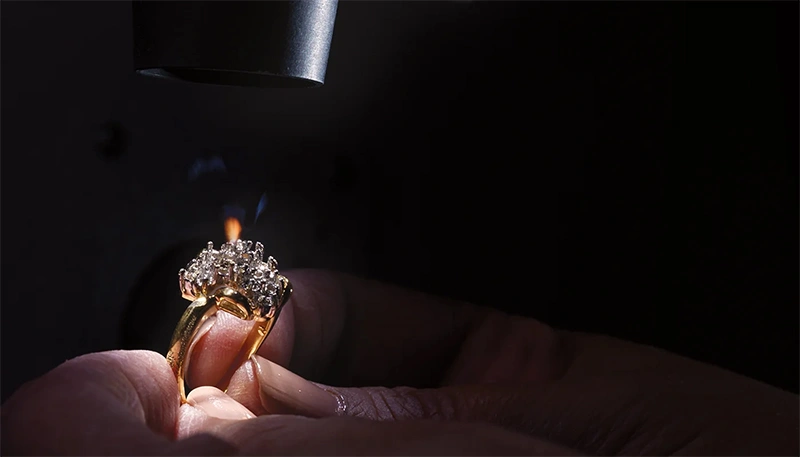
Yes, you can laser weld stainless steel jewelry, including many pieces made from 304 and 316L stainless steel. With a suitable jewelry laser welder, jewelers can repair broken chain links, close jump rings, join bracelet components, and restore certain damaged fittings without heating the entire piece.
However, stainless steel requires careful control of laser energy, pulse duration, joint preparation, and oxidation. Incorrect settings can cause burn-through, discoloration, porosity, or weak welds, especially on thin jewelry components.
For jewelry repair shops and goldsmiths, the main challenge is not simply whether stainless steel can be welded, but how to create a reliable joint without damaging the surrounding jewelry.
This guide explains which stainless steel jewelry can be laser welded, how to choose appropriate welding settings, and how to avoid common repair problems.
1. Can You Laser Weld 304 and 316L Stainless Steel Jewelry?
Both 304 and 316L stainless steel are commonly used in jewelry components and can be laser welded under suitable conditions.
The exact alloy matters because different stainless steel grades can respond differently to welding, particularly in terms of cracking behavior, corrosion resistance, and filler metal selection.
304 vs 316L Stainless Steel for Jewelry Welding
Material | Common Jewelry Applications | Welding Considerations |
|---|---|---|
304 Stainless Steel | Fashion jewelry, pendants, chains, decorative fittings | Generally weldable with suitable joint preparation and settings |
316L Stainless Steel | Bracelets, rings, chains, and corrosion-resistant jewelry components | Weldable, but heat control and appropriate filler selection are important |
Unknown Stainless Steel Alloy | Unmarked or mixed-material jewelry | Identify the material before attempting critical repairs |
Plated or Coated Stainless Steel | Gold-colored, black-coated, or decorative jewelry | Coatings may discolor, burn, or require refinishing around the weld |
316L contains molybdenum and has a low carbon content, contributing to its corrosion resistance and making it a common choice for jewelry exposed to moisture or frequent wear.
However, the presence of 316L stainless steel does not guarantee that every component can be repaired successfully. The joint design, material thickness, and surrounding parts must also be considered.
Which Stainless Steel Jewelry Can Be Laser Welded?
A jewelry laser welder can be useful for several common repair applications.
Chain links and jump rings: Broken or open links can often be rejoined when the ends fit closely and the material is suitable for welding.
Bracelets and watch-band components: Certain cracked links, connection points, and metal fittings may be repaired without heating the entire assembly.
Rings and pendants: Small cracks, joints, or attachment points can sometimes be welded, depending on their thickness and construction.
Clasp attachments: Connecting rings and external fittings may be repaired, but damaged spring-loaded clasp mechanisms are often better replaced.
Jewelry containing unknown alloys, delicate coatings, heat-sensitive inserts, or inaccessible internal mechanisms requires additional evaluation.
Not every stainless steel jewelry repair should be welded. Sometimes replacing a small damaged component provides a more reliable and economical result.
2. Why Is Stainless Steel Jewelry Difficult to Laser Weld?
Stainless steel behaves differently from precious metals such as gold and silver, and the same careful control applies if you laser weld titanium jewelry.
Although laser welding concentrates heat in a small area, stainless steel can develop local overheating, oxidation, distortion, or cracking if the welding conditions are unsuitable.
Heat Control and Thin Jewelry Components
Stainless steel generally has much lower thermal conductivity than pure gold or silver, so heat can remain concentrated near the weld.
This can be useful for localized fusion, but it also creates a risk of overheating delicate components.
Thin chain links, hollow pendants, and small clasps may deform or burn through if too much energy is applied.
Using carefully controlled pulses helps limit unnecessary heating, but the correct setting depends on the material thickness, joint shape, and laser system.
Oxidation and Corrosion Resistance
Stainless steel forms a protective chromium-rich oxide layer that contributes to its corrosion resistance.
During welding, excessive heat or inadequate shielding can produce visible heat tint and oxidation around the joint.
Some welding conditions can also affect the material's local corrosion resistance, particularly when the alloy experiences unfavorable heating or cooling.
A clean joint, suitable shielding gas when required, and controlled heat input help reduce these problems.
For jewelers, the goal is to achieve sufficient fusion while minimizing discoloration and unnecessary damage to the finished surface.

3. How to Laser Weld Stainless Steel Jewelry
Successful stainless steel jewelry welding starts with proper preparation and controlled testing.
Rather than applying a fixed parameter chart to every piece, adjust the welding process according to the alloy, material thickness, and actual weld response.
Jewelry Laser Welder Settings for Stainless Steel
The most important settings to understand are pulse energy, pulse width, spot diameter, and pulse frequency.
Parameter | What It Controls | Practical Consideration |
|---|---|---|
Pulse Energy | Energy delivered during each pulse | Excessive energy may cause burn-through; insufficient energy may leave weak fusion |
Pulse Width | Duration of each laser pulse | Influences heat input, melting behavior, and weld formation |
Spot Diameter | Size of the focused welding area | Smaller spots concentrate energy; larger spots distribute it over a wider area |
Pulse Frequency | Number of pulses per second | Affects welding rhythm and heat accumulation |
Shielding Gas | Protection of the molten metal | Suitable argon shielding may help reduce oxidation and contamination |
There is no universal stainless steel jewelry welding setting that works across every machine.
A 0.3 mm stainless steel chain link requires a different approach from a thick bracelet fitting. Similarly, a pulsed Nd jewelry welder and a QCW fiber laser welder may use different controls and parameter ranges.
Start with the manufacturer's recommended settings for the specific material and machine. Test on matching scrap material, then adjust gradually while inspecting the weld.
Step-by-Step Stainless Steel Jewelry Welding
Step 1: Identify the Material
Confirm whether the jewelry is made from 304, 316L, or another known stainless steel grade.
Check for plating, coatings, gemstones, springs, adhesives, and other components that could be damaged by welding.
Step 2: Clean and Prepare the Joint
Remove oil, polishing residue, and surface contamination using cleaning methods compatible with the jewelry.
If necessary, prepare the local joint surface without damaging surrounding decorative finishes.
Align the broken ends closely and secure the piece with a suitable jewelry fixture.
Step 3: Set Up the Laser Welder
Select the appropriate settings on your laser welder for jewelry.
Begin with a conservative, manufacturer-supported parameter range and evaluate the result on matching scrap material.
Use suitable shielding gas where required by the machine and welding procedure.
Step 4: Tack the Joint
Apply controlled tack welds to hold the components in position.
For thin links or delicate fittings, avoid concentrating excessive heat in a single area.
Inspect the alignment before completing the weld.
Step 5: Complete the Weld
Build the joint using controlled laser pulses. Where appropriate, overlapping weld spots can help create a continuous joint.
For closely fitted components, welding without filler may be possible. If a gap requires additional metal, select a compatible stainless steel filler based on the alloy and repair requirements.
Avoid assuming that one filler wire is suitable for every stainless steel grade.
Step 6: Inspect and Finish
Examine the welded area under magnification for cracks, pinholes, incomplete fusion, and excessive surface buildup.
Where appropriate, check the repaired component's mechanical function and joint strength using a suitable inspection method.
Finish and polish the area carefully. If required, restore the surface's corrosion-resistant condition using a treatment compatible with the jewelry.
For safe operation, use the laser enclosure, protective viewing system, fume extraction, and other controls specified for the equipment and applicable laser safety requirements.

4. Common Stainless Steel Laser Welding Problems and Fixes
Even with appropriate equipment, stainless steel jewelry can develop defects when the heat input, surface preparation, or joint alignment is incorrect.
Recognizing these problems helps jewelers improve repair quality without repeatedly applying more laser energy.
Welding Problem | Likely Cause | What to Check |
|---|---|---|
Burn-through or holes | Excessive energy concentration or very thin material | Reduce heat input, review spot size, and check joint fit |
Weak or incomplete weld | Insufficient fusion, poor alignment, or contamination | Improve fit-up and adjust welding conditions on a test piece |
Dark discoloration | Oxidation, excessive heat, or poor shielding | Check cleaning, gas coverage, and heat input |
Porosity or pinholes | Surface contamination, gas entrapment, or unstable welding | Clean the joint and review shielding and pulse settings |
Cracks near the weld | Alloy sensitivity, unsuitable filler, or excessive restraint | Verify material grade, filler choice, and welding procedure |
Distorted jewelry | Excessive accumulated heat or poor fixturing | Reduce heat accumulation and improve component support |
How to Avoid Weak or Brittle Welds
A weld that looks smooth is not necessarily strong.
Incomplete fusion, internal pores, or cracking can weaken a connection even when the surface appears acceptable.
This is particularly important for bracelet links, jump rings, and other components subjected to repeated movement or tension.
Whenever possible, test the procedure on representative material before repairing customer jewelry.
If cracking continues despite suitable preparation and controlled settings, stop and reassess the alloy, joint design, and filler selection.
How to Reduce Discoloration
Discoloration around the weld is often associated with oxidation and excessive local heating.
Cleaning the material, maintaining suitable shielding, and avoiding unnecessary heat buildup can help reduce visible heat tint.
However, polishing alone may not fully restore corrosion resistance if the surface has been significantly affected.
For finished stainless steel jewelry, evaluate both appearance and the condition of the repaired surface before returning the piece to the customer.

5. When Should You Repair or Replace Stainless Steel Jewelry?
Laser welding is useful for many stainless steel repairs, but it is not always the best solution.
Jewelers should consider the value of the item, accessibility of the damaged area, strength required, and risk to surrounding components.
When Laser Welding Makes Sense
Laser welding is often worth considering when:
A chain link or jump ring has separated but remains otherwise undamaged.
A bracelet component has a localized crack that can be accessed and supported.
A small stainless steel fitting needs a precise welded connection.
The piece has sentimental or commercial value that justifies repair.
A jewelry repair laser welder can help workshops handle these small, precise tasks with localized heat input.
It can also reduce the need to expose a larger portion of the jewelry to heat, although nearby stones, coatings, adhesives, and mechanical components must still be assessed individually.
When Replacement Is the Better Choice
Replacing the damaged component may be preferable when the clasp's internal spring is broken, the metal is severely worn, or the original joint cannot provide adequate strength after welding.
Unknown alloys, plated components with difficult-to-restore finishes, and very thin hollow jewelry may also present unnecessary repair risks.
For a low-cost clasp, replacing the complete fitting may be faster and more reliable than attempting to rebuild a damaged mechanism.
Is a Jewelry Laser Welder Worth It for Stainless Steel Repairs?
For jewelry stores and goldsmith workshops, stainless steel repairs can be one part of a broader laser welding service.
A jewelry laser welding machine can also support suitable gold, silver, platinum, and other metal jewelry applications, depending on the machine and material.
The investment becomes more practical when a workshop regularly handles chain repairs, clasp connections, custom assembly, and other precise welding tasks.
Before choosing equipment, consider the material types you work with, the size of your typical repairs, available welding modes, ease of operation, and after-sales technical support.
Conclusion
Stainless steel jewelry can be laser welded successfully, but achieving a reliable repair requires the right material, controlled welding settings, and careful joint preparation.
Both 304 and 316L stainless steel can be suitable for laser welding. However, thin components, plated surfaces, and complex clasp mechanisms require special attention.
For jewelers, the best approach is to identify the alloy, test the welding settings, minimize unnecessary heat, and inspect the finished joint before returning the piece to the customer.
Laser welding can be a valuable addition to jewelry repair services, particularly for small links, bracelet connections, and precision assembly work that benefits from localized heating.
Looking for a jewelry laser welder for stainless steel repairs? Contact JewelryLaserNova to discuss your materials, typical repair tasks, and workshop requirements. Our team can help you compare suitable jewelry laser welding equipment, review sample welding applications, and choose a machine that fits your business needs.